AI proofreader speeds up workflows for Disasters Emergency Committee

The Disasters Emergency Committee (DEC)

Joining together with the DEC team for a mock appeal
The client
The Disasters Emergency Committee (DEC)
The Disasters Emergency Committee (DEC) brings together 15 leading UK aid charities to raise funds quickly and efficiently during humanitarian crises. Emergency appeals typically launch within 24 hours of approval, and a huge amount of content needs to be produced in that time. Press releases, emails, adverts, social content, and supporter communications are being developed simultaneously by multiple teams. An added challenge is that messaging can evolve rapidly as new information becomes available.
As part of our long-standing partnership with the DEC, we developed an AI-assisted proofreading tool to help teams review content more efficiently and drive faster, better quality outcomes.
Our approach
Building on the DEC's wider AI journey
Over the past 18 months, we've worked closely with the DEC to build confidence around AI, supporting everything from AI literacy and organisational readiness through to governance, policies and practical experimentation.
Together, we ran an AI Fundamentals workshop to explore opportunities, risks and possible use cases. We also supported them to develop responsible AI principles and create space for teams to experiment safely with existing tools before investing in bespoke solutions. This work generated a broad range of ideas, but the team wanted to identify a first pilot that was practical, useful and low risk.
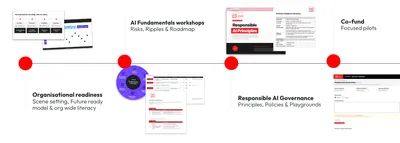
Timeline of AI projects including organisational readiness, AI Fundamentals workshop, responsible AI governance, and co-funded pilot
To help prioritise opportunities, we assessed them against these factors:
- Their potential impact on the organisation and alignment with organisational goals
- Their potential value for staff
- How practical they would be to test and implement
- The risks they could introduce and how those risks could be mitigated
Alongside impact and feasibility, the team wanted to ensure any pilot could be explored responsibly. That meant understanding not only where AI could add value but also where human oversight, governance and safeguards would need to remain firmly in place.
For an organisation operating in such a high-stakes environment, responsible innovation was central to the approach. AI needed to complement existing processes rather than introduce unnecessary risk. We explored the risks and ripple effects of AI use at various stages of the workflow and what best-in-class mitigation and elimination strategies looked like.
For the DEC, this made proofreading an ideal first pilot. It addressed a real operational challenge, had clear success criteria, and could be tested safely while keeping human judgement at the centre of the process.
Supporting existing expertise rather than replacing it
The DEC team are highly experienced at communicating complex humanitarian situations accurately and sensitively. Instead of using AI to write appeal content we used it to reduce some of the repetitive review work that sits around it.
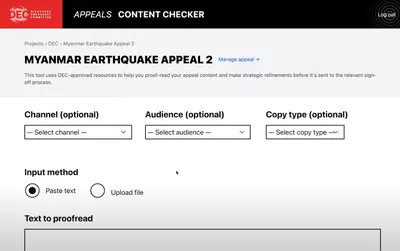
Proofreading tool that allows users to select channel, audience, and copy type when reviewing text.
The resulting proofreader allows users to submit content and receive feedback that factors in brand guidelines, appeal-specific guidance, and best practices for the format of that content. It can flag deviation from approved messaging, outdated statistics, factual errors, confusing phrasing, incorrect terminology, spelling and grammar issues, and spot content that exceeds platform character limits.
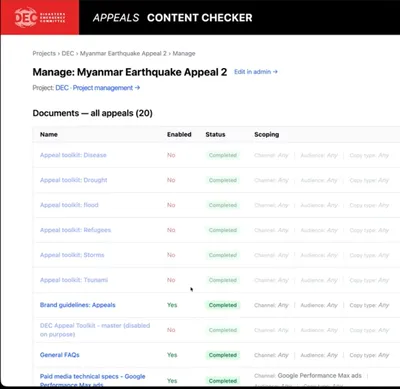
Documents the proofreader uses to inform its recommendations including brand guidelines, FAQs, toolkits for responding to different types of disasters, and technical specs for different channels.
Importantly, users remain responsible for reviewing suggestions and deciding whether to apply them. The tool was designed to support judgement rather than replace it, helping teams work more efficiently while keeping people firmly in control of the final output.
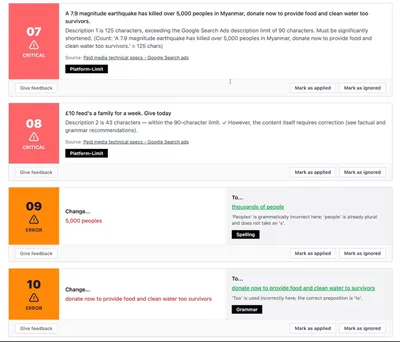
Proofreading feedback on critical problems and minor errors with options to mark as applied or ignored.
Testing the tool with a mock appeal
To understand how the proofreader would work in practice, the DEC team created a mock humanitarian emergency scenario, based on a real-world situation. Colleagues from fundraising, communications, digital marketing, supporter services and partnerships took part. After receiving a briefing, participants produced content as they normally would and used the proofreader as part of the review process.
This approach allowed the DEC to understand how the tool fitted into existing workflows, gather structured feedback and identify areas for improvement without introducing risk into a live emergency response.
What the pilot showed
- 100% of participants said they found the tool valuable.
- 73% said they would continue using it.
- 64% reported that it helped them work more quickly.
One of the most interesting findings was around trust. Participants “generally trusted” the tool's suggestions, but still applied their own judgement when reviewing content. This was an important balance as the goal was never for people to blindly accept AI recommendations.
The pilot demonstrated that AI could help reduce friction in a critical workflow while maintaining the quality controls and human oversight that are essential during emergency appeals.
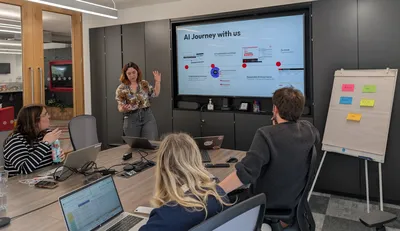
Iona presenting to the DEC team
Looking ahead
What's next?
Following the pilot, the DEC is reviewing the feedback gathered from participants and using it to prioritise future development.
Alongside improvements to the proofreading tool itself, the team is also exploring how the same approach could support other content types, including internal impact reports and policy documents.
The pilot has also provided a useful foundation for revisiting some of the wider opportunities identified during the earlier AI Fundamentals workshops. With an initial use case now tested and validated, their team are in a stronger position to assess where AI could deliver value across other parts of the organisation.
Exploring AI opportunities in your organisation?
Through our Employee Ownership Trust Innovation Fund, we’re helping charities to explore ideas like these by co-funding AI proofs of concept that have the potential to create real impact.
If you're curious about how AI could help your organisation reach more people, improve services or work more effectively, we'd love to hear from you - get in touch.

More
-

-
Recruiting volunteers for RNID through a multi-channel campaign
Royal National Institute for Deaf People (RNID)
-

- See more work


