

Lessons learned from councils navigating Local Government Reorganisation
How do you redesign organisations while continuing to deliver essential frontline services every day? How do you support staff through years of uncertainty and change? How do you prioritise transformation work when capacity is already stretched? And how do you create future councils designed around residents, not organisational structures?
These questions shaped discussions throughout LGRCamp East Midlands, where local authority leaders, transformation teams, digital professionals and delivery partners came together to share honest reflections, practical advice and lessons learned from their own Local Government Reorganisation (LGR) journeys.
Across the day, conversations covered everything from governance and operating models to communication, culture, service design and resident experience. But while every session approached LGR from a slightly different angle, the same themes surfaced repeatedly: balancing transformation with business-as-usual delivery, avoiding staff burnout, creating clarity during uncertainty, and designing future organisations deliberately rather than reactively.
Here are some of the key themes, lessons and practical insights shared throughout the day.
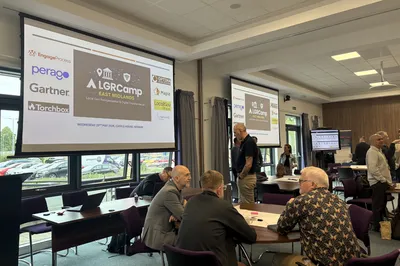
Vesting Day is just the beginning
One of the clearest themes throughout the day was that Vesting Day is not the end goal. Again and again, speakers described it as the start of a much longer transformation journey.
Dave Richardson from Newark and Sherwood District Council described the current phase of Nottinghamshire’s LGR work as one of intensive planning, data gathering and alignment across multiple councils to establish what he described as a “minimum viable council” for day one.
For many attendees, success on Vesting Day wasn’t about residents experiencing dramatic change overnight. In fact, quite the opposite.
Minimum viable council is what’s really required for day one. There should be little to no change from a resident perspective. Longer term, what there should be is a much slicker, more efficient, and more cost-effective council as we merge.
The challenge many councils are navigating is how to stabilise services and systems first, while creating the conditions for more meaningful transformation over the years that follow.
Kate Hurr from Cumberland Council reflected openly on the complexity of balancing operational delivery with longer-term innovation and service redesign, particularly several years into Cumberland’s own LGR journey.
Some of the biggest challenges we’re facing are prioritisation, and how we navigate so many programmes of change all at once, and how we use our scarce resources in the most cost-effective way. We took a lot of time to do discovery work, get under the skin of what problems people are facing, and how we can introduce technology to support them. Being worried about this and asking questions doesn’t mean you’re not being ambitious or innovative, it just means you’re navigating huge change. You can feel scared of it whilst being innovative. Be measured and pragmatic, and be kind to yourself.
That balance between pragmatism and ambition came up repeatedly throughout the day.
LGR is a people challenge before it’s a technology challenge
Although systems, governance and infrastructure formed part of the conversation, the day was overwhelmingly about people.
Several speakers reflected candidly on the emotional reality of large-scale organisational change: uncertainty, fatigue, communication challenges, and the difficulty of maintaining morale and momentum across long-running transformation programmes.
Eloise Shingler-Leahy from Gedling Borough Council described the uncertainty councils can face while waiting for decisions about future structures and geography, as well as the cumulative impact of continuous change programmes on teams already under pressure.
We’ve had a lot of restructures across the organisation in the past few years, so everyone’s exhausted with the level of change. We’re working on a lot of transformation already, so there’s definitely a feeling of ‘why are we changing now if we’re going to have to change again very soon?’ One of the biggest lessons we’ve learned is that you can never communicate enough. Just when you think you’ve told people everything they need to know, you need to tell them three, four, five or six more times.
Communication, trust and psychological safety surfaced repeatedly across the event, particularly in sessions focused on change management and organisational culture.
Cheryl Doran from Gartner and former IT Enabler Lead on the Future Northants programme, reflected on the importance of helping teams move psychologically towards the future organisation, rather than remaining attached to legacy structures, systems and ways of working.
At the start of the journey, everyone’s playing what I used to call ‘Application Bingo’. Everybody wants their processes, systems and applications to survive the transition. One of the things Future Northants did really well was creating a strong identity around the new organisation early on, so people started thinking about the future council rather than grieving their old organisation. Building relationships, trust and shared ways of working early makes a huge difference.
What stood out throughout the day was how openly people shared both the challenges and the lessons they were learning in real time. The atmosphere felt collaborative and supportive, with attendees openly comparing experiences, approaches and concerns.
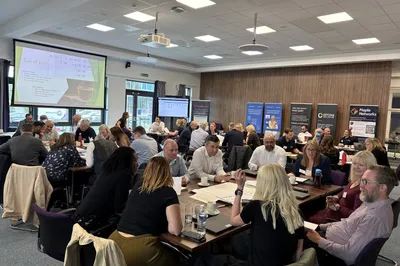
Designing future councils deliberately
Several sessions focused on the importance of creating clarity and direction amidst the scale and complexity of LGR programmes.
One workshop explored the challenge of merging processes and ways of working across multiple organisations, using the intentionally simple example of making a cup of tea to demonstrate how even straightforward processes become shaped by culture, systems, habits and history over time.
Rather than simply deciding whose process “wins”, discussions focused on how councils can deliberately design future approaches together around resident need, practicality and long-term sustainability.
Another session explored the importance of creating a shared “change narrative” across organisations, helping teams understand not only what is changing, but why. Speakers discussed councils uncovering hundreds of overlapping transformation projects running simultaneously across siloed teams, often without shared visibility or prioritisation.
Robert Musekiwa from the Future Northamptonshire programme, shared the importance of defining the future organisation intentionally, rather than reacting tactically to immediate pressures.
Local Government Reorganisation isn’t difficult just because of the scale, but because of the consequences that come out of it. Every LGR will succeed or fail based on the quality of the decisions leadership make. Start from the end. Start from the intent you have for the organisation you want to become, then work backwards from there. That way you know what decisions you need to make today.
That idea of designing deliberately, rather than simply consolidating existing structures, appeared throughout the day.
Keeping residents at the centre
While many discussions focused on governance, delivery and organisational change, resident experience remained a consistent thread throughout the event.
Dave Richardson spoke about the importance of designing future councils around residents and service users, particularly when thinking about digital services, websites, telephony and customer journeys.
Several sessions also highlighted the opportunity LGR creates to rethink fragmented processes and create more joined-up, human-centred services rather than simply replicating existing organisational structures inside a new authority.
That same thinking also shaped the collaborative workshop led by our own Dom Baker and Mark Boyle, which invited attendees to step away from governance structures and operating models to imagine what life could actually look like in 2031 if LGR succeeds for residents, communities and council teams.
Using speculative futures thinking and resident personas, groups explored futures shaped around belonging, connection, clearer service pathways and stronger communities.
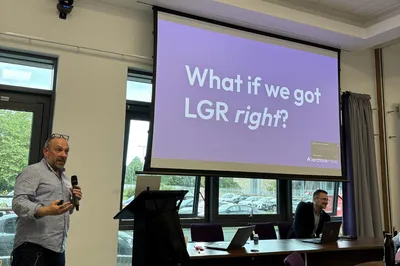
After a day of practical discussions around governance, systems, communication and delivery pressures, the session reinforced something that had surfaced throughout the event already: beneath the operating models, migration plans and transformation programmes, the strongest conversations kept returning to people, place and community.
More
-

What our Paul Mellon Centre research revealed about digital journeys for galleries, libraries, archives and museums
Cassandra Christodolo Senior User Researcher
-

Innovation with integrity: what we learned from our first GLAM Leaders' Breakfast
Lisa Ballam Marketing Director, Trustee Director
-

Imagining better futures beyond Local Government Reorganisation
Ellie Ashman Director of Public Sector Practice
- See more posts