
Innovation with integrity: what we learned from our first GLAM Leaders' Breakfast
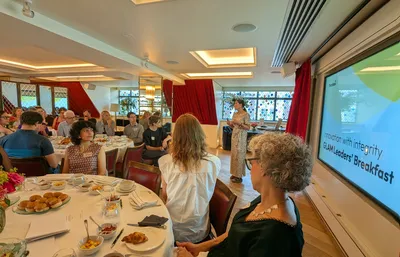
Opening the morning with a warm welcome.
If AI is the answer, what was the question?
This framing, from Dr Oonagh Murphy, set the tone for our first GLAM Leaders' Breakfast, and it turned out to be the most useful lens for everything that followed.
We brought together a group of 30 senior leaders from across the GLAM sector at The Ivy Club in London for a conversation about AI and what it means to use it responsibly, how to bring your organisation with you, and what happens when the hard questions don't have easy answers.
We were joined by Oonagh, alongside Trish Thomas from London Museum and Matt Plowright from Migration Museum. Here are some of the themes discussed.
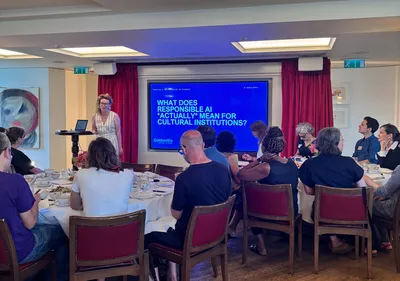
Dr Oonagh Murphy challenged the room to think about what responsible AI really means for cultural institutions.
Are you asking the right questions?
Responsible AI has replaced ethics as the organising principle, and that shift now asks organisations to be specific rather than well-intentioned.
That means being ethical, but also safe and trustworthy. Before deploying anything, ask three questions.
- Is it technically possible?
- Is it legally permitted?
- Is it aligned with the values of your organisation?
Those questions stop you getting swept up in the shock and awe of what AI can do, and ground you in what it should do.
Cultural institutions, Oonagh argued, are actually well placed to lead on this. They bring history and futures thinking, creativity and accountability, experimentation and care.
Everyone needs to own it.
A thread that ran through the whole morning was the importance of involving people across the organisation, not just technical teams, in shaping how AI is used.
At London Museum, the AI policy was shaped by a working group that spans the organisation. If you write a policy in isolation and hand it down, people opt out. If they help write it, they take ownership. Oonagh added that frameworks differentiated by team, so curators, digital teams and leadership each have something relevant to their own work, are far more useful than a single top-down document.
Stakeholder management is the key.
Trish highlighted that the technical work is not the hardest part. Getting non-technical colleagues to trust the process and feel like they're on the journey with you is where it really matters. For Clio, London Museum ran three months of testing with specialist and non-specialist users before any public launch. That testing exposed issues, such as seventy years of curatorial language in their collections data being surfaced, language that isn't appropriate today. They trained Clio to use correct, inclusive language, and were transparent about the fact that this is an ongoing process, not a solved problem.
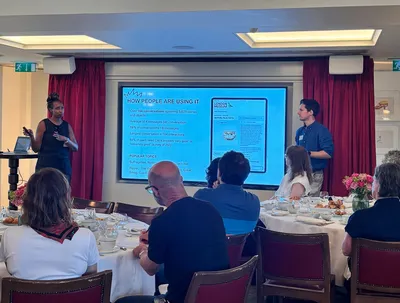
Ben and Trish shared how London Museum is using AI to help people discover more personal connections with its collections.
AI and the environmental question.
One of the most common concerns about AI is its environmental impact, and it's a legitimate one. But Oonagh encouraged the room to explore the concern rather than accept it at face value. Sometimes you'll find that AI is genuinely the wrong choice. Sometimes you'll find the reality is more nuanced than the headline.
London Museum took that approach with Clio, making a deliberate decision to use a small, efficient model specifically to minimise energy consumption. To put it in perspective, 500 to 1,000 queries uses roughly the same energy as boiling a kettle — still significantly more than a Google search, but a very different picture to the large-scale models that tend to dominate the environmental debate. The question needs to be asked, and the answer should shape the decision.
I came. I fell in love. I stayed.
One of the most quietly powerful moments of the morning came from Matthew's slides with this quote about migration, I came. I fell in love. I stayed.
That simplicity is at the heart of what the Migration Museum is building. Their AI-powered platform isn't just about surfacing objects and stories, it's about helping people find an echo of their own story in someone else's, and to stumble across collections in surprising and unexpected ways. For communities who may never walk through a museum door, that matters enormously. And it only works if you design for how people actually access technology.
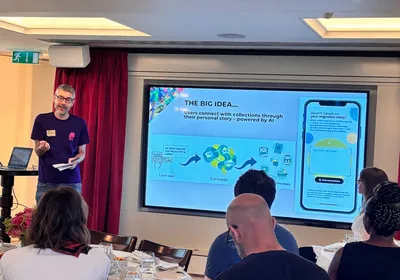
Matt from Migration Museum explored how AI can help people connect their own stories with museum collections in meaningful ways.
Be honest about what you don't know yet.
Both London Museum and Migration Museum demonstrated the same disciplined approach: test extensively before going public, build in human editorial override at every stage, and be honest about limitations. The Migration Museum's prototype has around 800 objects. The AI sometimes makes connections that aren't fully accurate. The answer isn't to pretend otherwise, it's to retain control, keep testing, and be transparent with your users.
The honest conclusion from the morning: responsible AI in the cultural sector is entirely possible. But it requires asking better questions, involving more people, and being willing to say we're still working on this. That's what integrity looks like.
Interested in exploring what this could look like for your organisation?
Find out more about our AI Co-fund or get in touch below to chat.
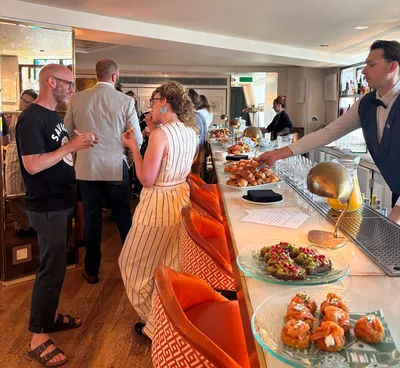
Conversations started early with coffee and tasty breakfast canapés.
More
-
What could your team achieve with an AI co-investment?
Lisa Ballam Marketing Director, Trustee Director
-

Continuous innovation with the Royal College of Art
Helen Roberts Senior Website & Content Manager at Royal College of Art
-

How AI is transforming the way we discover art and culture online
Ben Heasman Client Partner (Public Sector)
- See more posts