Using AI to connect migration stories across the UK's museums
At the Migration Museum, we're creating the UK's missing museum. It's a landmark new cultural destination exploring how the movement of people to and from these shores has shaped who we are, where we come from and where we're going, as individuals, as communities and as a nation.

Migration Museum

Visualisation of galleries in the Migration Museum's new permanent home, opening in 2028
Image: Unknown Works
The background
A collections strategy, with a difference
Over the past decade our team has worked with a huge range of partners and collaborators to co-create interactive, story-led exhibitions and events from a series of temporary and pop-up venues. We've reached audiences that are younger and far more ethnically and socio-economically diverse than most museums and heritage organisations, and run topical, high-profile digital campaigns that have reached millions of people. Our learning programme reaches thousands of students a year through facilitated workshops, and many more through teacher training and partnerships. Our Migration Network convenes museums, heritage organisations, charities and academics from across the UK to encourage and support greater exploration of migration themes.
Now we have a once-in-a-generation opportunity to create a permanent Migration Museum in the heart of the City of London, opening in 2028, powered by a network of pop-ups and partnerships across the UK.
We've never had a formally recognised collection of our own, although over the past decade we've gathered tens of thousands of personal migration stories and oral histories for our temporary exhibitions. As we prepare for our permanent home, we're developing our collections research strategy. It's still a work in progress, but we're likely to build a modest foundational collection of our own rather than trying to amass something large or duplicate what already exists across the GLAM sector. Instead, we want to signpost and make accessible what's already out there relating to the themes we explore.
That's the thinking behind this proof of concept. We wanted to explore whether an AI-powered dispersed digital collection, made up of migration stories and objects held by us and by partners across the GLAM sector, could give people engaging and intuitive ways to discover stories that resonate with their own experiences. If it worked, it could help to shape our future collections strategy – and help fill a gap in the sector as a whole.
The challenge
The problem we're trying to solve
Most people in the UK have a museum within reach of where they live or work, and many of these hold objects and stories connected to migration. But those stories often aren't on display, aren't easily accessible, or simply aren't framed as being about migration in ways that audiences might find. That's especially true for people from communities generally under-represented in museum audiences. There's no unified collection or database that the public, or researchers, can search to find migration-related material that might be relevant to them.
There are lots of reasons for this. Some are specific to individual institutions, some are sector-wide, some are systemic. The fact that the UK still lacks a permanent institution dedicated to this theme is telling in itself. Migration is often framed as a contemporary problem or a contentious issue, or seen through the lens of one community, time period or place, rather than as something central to our collective history and identity.
Through our sector-supporting Migration Network, we also know there are plenty of people working in the sector who want to tell these stories and make them accessible, but who often find themselves working in isolation or unsure of the best way to do it. That's where this project comes in.
The approach
Why AI felt like the right tool
Whatever your views on the benefits and risks of AI, it's clearly here to stay, and its capabilities are only going to grow. As a small, relatively young organisation with limited resources, and as a new museum not bound by legacy systems or collections, we're well placed to explore what AI can do to help us maximise our reach and impact.
We worked with Torchbox to carefully trial and evaluate our use of AI in the early stages of this platform, and we're grateful that the National Lottery Heritage Fund understood the value of funding a prototype at this stage, rather than expecting us to build a fully public-facing product without the chance to test and refine it first.
We've used AI in a number of ways, and the common thread running through all of them is that it lets us create stories for, and connections between, hundreds of objects across multiple collections quickly, contextually and within a budget and timeframe that simply wouldn't have allowed for it otherwise.
How AI works in practice
There are three ways AI is used within the platform.
Object stories: When we add new objects, whether held by us or by partner organisations, AI takes the uploaded catalogue information and turns it into short, readable, multi-panel stories. The model draws only on data already in our collections database rather than external sources, and its job is to tell each object's story in a consistent style and accessible tone. We can edit any AI-generated story to improve how it's told or correct inaccuracies. This has let us create stories for hundreds of objects quickly, which in turn has let us test the platform's potential in its early stages and share what we've learned with partners.
Themes and story discs: AI also looks across the objects in the dispersed collection to identify connections between them, which appear on the platform as theme pages and story disc pages. Theme pages group objects that share a common subject. Story disc pages link story discs, personal migration stories shared with us by visitors and digitised for the platform, to related objects, and tell each object's story in a tone that ties into that theme or story disc. Where the connections feel imperfect, we can edit the text and adjust which objects are linked to which pages. Both of these uses have let us build pages at speed and scale, with the ability to step in and improve or correct things where needed.
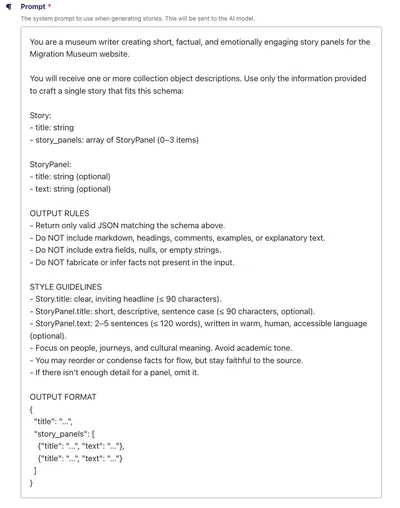
Screenshot of prompt used to generate Story panels in the Migration Collection proof of concept
Search based on your migration story
This is the most ambitious part of the platform, and the part that's needed the most thought. It lets users search and discover objects in the collection based on their own migration story. When someone shares aspects of their story through the search feature, AI finds objects that relate to it by looking for connections around places, time periods and experiences. We know that many visitors come to us looking for content that speaks directly to their own or their family's story. At the same time, our exhibitions and programming have always aimed to help people discover surprising or unexpected resonances with other people’s stories. This feature lets us serve both of those needs at once.
Our internal and user testing was broadly positive, but it also surfaced some concerns about how relevant the results felt. In some cases it wasn't clear what the connection was between an object and what someone had shared, and in others the results didn't feel relevant at all.
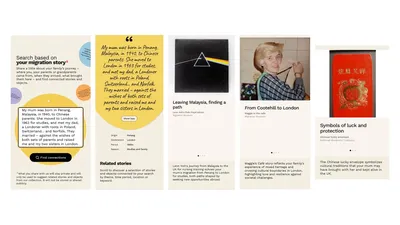
Migration Collection Story Search results screenshots featuring my own family's migration story
When results fall short
Irrelevance in these results is really two separate issues. One is a UX problem: users being confused about what they're being shown and why. To address this, we’ve focused on giving users a useful descriptive indication of the connection, for example by showing where a related story shares a location, region or theme identified in their own story.
The other is more serious, and it's about the risk of surfacing something inaccurate or insensitive, rather than simply off-topic. We uncovered a few examples of this during testing, and it’s something we're continuing to think carefully about as we test and refine the platform. At the moment, with only around 800 objects in the prototype, there are inevitably gaps that AI sometimes fills in ways that aren't fully accurate or appropriate, but we expect this to improve as the collection grows.
It's also worth saying that at this search stage, there's no language model generating new content, so there's no prompt to edit. What we can adjust is the similarity threshold, essentially how closely an object needs to match a user's story before it's shown at all. To date, with test audiences, we haven't felt the need to change it, but knowing that lever exists matters a great deal given the sensitivities involved.
Handling people's stories with care
We're honoured that so many people have entrusted us with their personal stories and family histories over the years, and we're acutely aware of the responsibility that comes with that. Working with AI adds a particular challenge here, and it's something both we and Torchbox have kept front of mind throughout.
We'd originally considered letting users add their own migration stories directly to our collection through this platform, but we quickly realised that combining this with the AI-powered elements of the platform would raise real difficulties. We decided to leave the story contribution out of this proof of concept and think about it separately from the AI-generated search results. As things stand, the text someone enters into the search function is used only to find relevant, connected results. It isn't saved to our collection and isn't used to train any external language models.
One of the main lessons we learned had nothing to do with AI itself, but to do with where we placed the search function on the page. In early versions of the product, the search sat right at the top of the homepage – the first thing anyone saw. Feedback from our first round of user testing showed that people didn't feel ready to share something personal, and potentially sensitive, at that early stage, even when we reassured them their input wouldn't be saved. We responded by moving the search function further down the page and adding a curated Featured Story module at the top instead, something we fully control, so we can build trust with users online in the same way we do with visitors to our physical venues before inviting them to share their own stories.
There's so much misinformation about migration online that it was essential that AI only draws on our own collections data rather than anything external. And because we can edit the object stories, themes and story disc pages, we've had a manual override in place from the start, something several of our GLAM partners raised as a key requirement during the discovery phase. In practice we've only needed to step in a handful of times, whether to adjust tone or correct an inaccuracy, but having that ability matters given what's at stake.
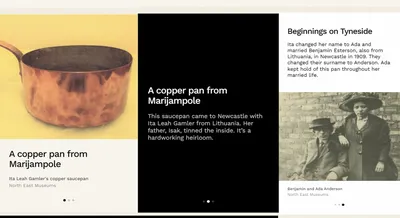
Migration Collection story panels generated by AI from the North East Museums catalogue entry
Next steps
Where we go from here
We're pleased with what we've built so far, and feedback from colleagues, partners and funders has been genuinely positive. As a proof of concept, the project has done what it set out to do: it's shown that the concept is valid and has real potential.
The next step is turning this proof of concept into a publicly launchable product, which means securing further funding. Alongside product development, we want to bring new partners on board and grow the number of objects and stories in the collection, since the more we have, the more relevant and rewarding the experience becomes for users. We also want to bring our full collection of visitor-shared story discs into the platform and make them easier to surface.
Longer term, we'd love visitors to our new permanent home to be able to explore this platform when we open in 2028, alongside visitors to our partner venues and, potentially, members of the public and researchers right across the UK. The final piece of the puzzle is working out where the ability for people to share their own migration stories with us fits in, whether that becomes part of this product or sits alongside it, feeding into the growing collection over time.
The potential here is enormous. We hope others share our excitement, and that some of what we've learned through this project can help inspire and inform the future of AI-powered digital products across the GLAM sector as a whole.
What could your team achieve with an AI co-investment?
If you've got an idea that could improve how people discover, access or engage with your collections, our AI co-fund can help you test it with confidence.

More
-

-
Connecting 23,700 NHS staff with one Intranet
Guy's and St Thomas' NHS Foundation Trust
-
NHS training system transformed with AI development platform
National School of Healthcare Science
- See more work


