
Imagining better futures beyond Local Government Reorganisation
How do you prepare for a major shift in the shape, remit and structure of your organisation, down to the place and people you serve?
That was the challenge we started from when we got the opportunity to run a workshop at LGRCamp, a one-day interactive conference for council leaders navigating Local Government Reorganisation (LGR), brought together by Nick Hill.
With a room full of local government leaders, transformers, and service leads at the end of a packed conference day, how might we pull together the disparate strands to close on an optimistic note that's still grounded in reality?
To us, the answer was clear - let's go and see the future.
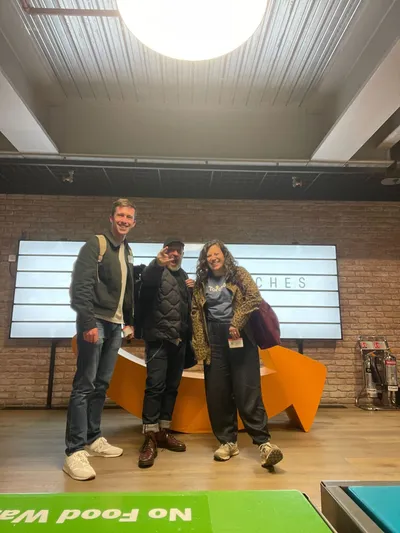
LGR represents 2 years of intensive change for impacted authorities, working towards a Vesting Day as a new unitary council by 2029. From our conversations with local gov teams and our work with Buckinghamshire Council, we know that Vesting Day is far from the end. In many ways it's just the beginning as a new organisation forms, staff and teams find their place and start shaping their norms and cultures, and essential frontline services keep running uninterrupted throughout.
We wanted to create the space to imagine what the world and each place represented in the room might look like not on Vesting Day, but in 2031 when LGR is 2 years in the rear view. Our fundamental question: what if it all goes right?
After introducing the concept and sharing some inspiring pockets of the future already popping up in communities all over the UK, we divided the room into groups for some futuregazing.
We wanted to help participants zoom out from the details of LGR - the risk registers, the budget lines, the comms plans - and imagine the future they'd like all that work to enable. To help set that important, loud day-to-day aside, we gave each group a set of character personas, some thinking prompts, and some gently structured sheets to think about what today might look like for their adopted persona.
Grounded in those tangible stories, we asked our groups to think about what a better 2031 might look like for those same imagined individuals. Approaches from Liberating Structures helped us facilitate here, using 1-2-4-all to turn those individual insights into pair work and then group work, before sharing back to everyone in the room. This helps make it feel safer to be brave, and creates space to refine and combine ideas together.
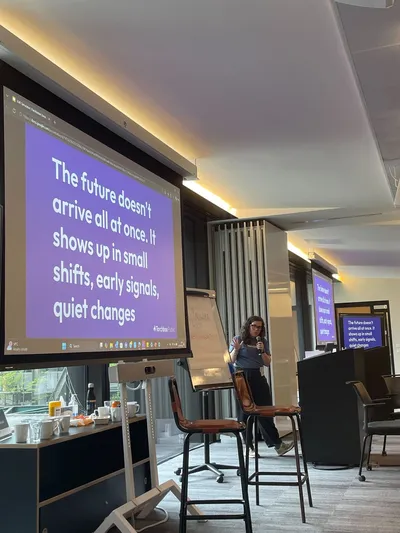
Because we wanted the session to support really valuable thinking and feel useful back in each participant's context, we threw in some curve balls along the way! During the group work, each group received a random "curve ball" card. Some got a familiar foe like a cyber security incident or pandemic, and one lucky group got an unexpected endowment to spend - we saw that groups found these useful for expanding or evolving their ideas, or for honing in on a key area of focus.
At the end of the session, each group told us the story of their imagined place, touching on the journeys of the personas now familiar to everyone in the room.
We were worried that a speculative session at the end of a busy conference day might be a big ask, but we needn’t have been concerned - all the attendees got stuck straight into imagining better futures for their place. As we walked the room and checked in with groups, we heard themes like:
- Supporting communities so that everyone feels seen, heard and valued - whether they’re a frontline council worker approaching retirement, or a young person leaving care and stepping into a place that he hopes he can feel part of
- Services that reach people - many groups described a future where the system enables connections and pathways that make sense, and difficult steps or interactions are always human to human
- AI and technology as the enabler, not the replacement - almost every future featured technology, but always as a barely-visible enabling layer to a much more human experience. Technology for reducing friction, not increasing distance and isolation
- Community as infrastructure - many groups treated community as an essential, load-bearing part of a better future. Community showed up as connection, resilience, diversity, and an active part of healthy and fulfilled people and places.
- Stability and the right to a future - particularly for the younger personas, many groups imagined futures that made it possible for young people to shape their own path and pursue lives that work for them. In some cases, something as simple as coherent support and a trusted source of stability in uncertain circumstances was a transformative future.
I love facilitating big, committed and energised groups and this was a brilliant example, but I was still bowled over by the depth, humanity and beauty in the stories each group told. Together, we wove a picture of a future that begins and ends with community. A future where nature is a visible, valued part of our daily lives, where travel can add beauty and connection in place of congestion and separation, where parents are supported by those around them, older people in our community are connected and cared for, and every child is able to thrive in their own wonderful way. A future where we can see our differences combined into strong, unified, joyful, resilient communities.
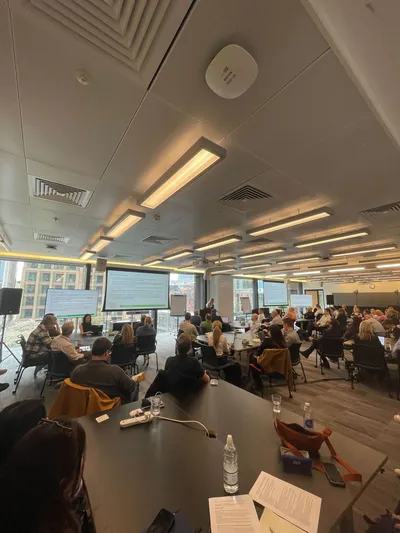
The session and the conversations it prompted are a testament to the incredible commitment and passion of the countless teams in local authorities across the UK working hard - often invisibly, rarely acknowledged- to operate essential services for all of us in incredibly constrained environments, solving problems with creativity, resourcefulness, open hearts and curious minds. It was a privilege to be part of.
LGR brings with it some really significant challenges, and pokes at some longstanding wicked problems for local authorities. These are rarely solvable with technology alone - the real work often begins with the conversations, the meetings, plans, maps, alignment sessions, tough conversations and key decisions. By inviting creativity and play into the room alongside our pragmatism and subject expertise, we can unlock new ideas and find new ways to explore, experiment, and get stuff done.
Looking for support with anything we've outlined above?
Ellie Ashman Director of Public Sector Practice
Get in touchMore
-

Rebuilding hope and responsibility - Camp Digital reflections
Diana Born Portfolio Manager (Public Sector)
-

Eight considerations before launching a public-facing AI tool
Mark Boyle Client Partner (Public Sector)
- See more posts
