




Rebuilding hope and responsibility - Camp Digital reflections
We recently headed back to Manchester for Camp Digital 2026, an event that continues to bring together thoughtful conversations around design, technology, accessibility and digital culture.
The event itself reflected many of those values too, from live captions and silent spaces to thoughtful accessibility considerations throughout the venue and sessions.
This year, many of the conversations focused less on technology itself and more on the people, cultures and systems around it.
Across sessions on healthcare, service design, accessibility, organisational culture and, invariably AI, a recurring theme emerged around how we create space for trust, creativity and participation in a period of rapid technological change.
Here are some of the themes and ideas that stuck with us.
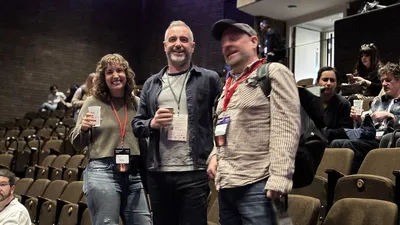
Rebuilding hope in technology
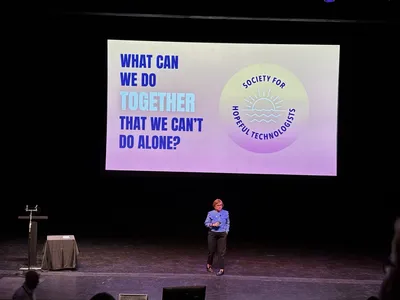
One of the strongest opening themes across the day was the idea of rebuilding hope and responsibility within technology.
Rachel Coldicutt’s talk introducing the Society for Hopeful Technologists reflected on the growing discomfort many people feel around the concentration of power within tech, from misinformation and inequality to the dominance of a small number of companies shaping digital experiences and perceptions of technology globally. But rather than framing that as inevitable, the talk focused on the role technologists can play in challenging those systems more critically.
It was a useful reminder that many people working in digital originally entered the industry because they wanted to improve things, not just optimise systems or scale products.
Several talks also explored what organisations need in order to respond thoughtfully to change. One idea, shared by Himal Mandalia, was the importance of creating enough slack in systems, whether personal, organisational or technical, to notice when things are going wrong. Without that space, teams can become trapped in constant reaction mode, where short-term fixes gradually become the system itself.
There were also thoughtful discussions around psychological safety and accountability within teams, particularly the importance of creating cultures where people feel able to raise concerns, challenge decisions, and acknowledge when something isn’t working.
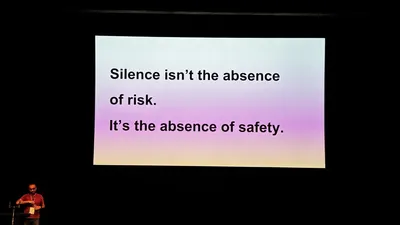
One line that particularly stayed with us was:
“Silence isn’t the absence of risk, it’s the absence of safety.”
Taken together, these conversations felt less about technology itself and more about the kinds of cultures, behaviours and environments needed to build better systems in the first place. We’ve been thinking a lot about the conditions we need to create and nurture to enable the deeper and more impactful work our clients are increasingly bringing to us, and this talk gave all of us some new insights to contribute to that thinking.
Serious work needs space for play
A recurring theme throughout the day was the relationship between creativity, experimentation and organisational culture.
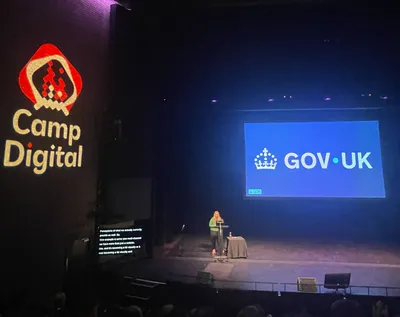
Laura Yarrow’s talk explored how GOV.UK has been rethinking design and creativity as the platform matures, particularly given the challenge of designing for users ranging from teenagers to people in their nineties. GOV.UK is now approaching 15 years old, and part of the challenge has been introducing more playfulness and experimentation, both internally and externally, while still maintaining trust and clarity.
One idea that particularly resonated was that culture often fuels creativity more effectively than process alone. When organisations create space for experimentation, curiosity and play, people are more willing to explore ideas, challenge assumptions and try new approaches. This has got us thinking and talking about how we consistently hold space for this kind of reflective, playful practice in the day to day rhythms of budgets, deadlines and strategic planning cycles.
That spirit also came through in some of the more interactive sessions and lightning talks throughout the day. Camp Digital x 300 Seconds showed how low-pressure, accessible formats can create space for people to share ideas and experiences in ways that feel more open and participatory. One quote that captured this particularly well was:
“Confidence is the receipt for doing the thing you fear.”
There were also several examples of organisations using playfulness and participation as practical tools for engagement rather than simply stylistic choices. Open Data Manchester’s workshop explored ideas around psychogeography, public participation and “playful demystification”, using creative prompts and collaborative exercises to encourage people to notice shared spaces differently and think more openly about how data can support participation and decision-making.
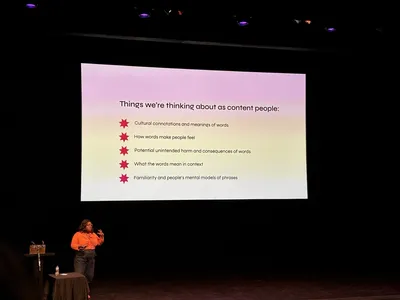
Candi Williams’ session on content strategy also reinforced how much digital experiences depend on context, structure and clarity. One of the strongest reminders from the session was that people engage with online content very differently from physical environments, which means language, hierarchy and structure play a significant role in how information is understood.
There was also a strong argument for involving content design earlier in projects, rather than treating it as something layered on towards the end of delivery. As AI tools become increasingly capable at generating copy, the strategic side of content work, understanding context, intent and meaning, arguably becomes even more valuable. Candi’s talk also showed us how professionalism and play can coexist really powerfully, with bright slides, light jokes and playful word choices sharing space with clear frameworks and a checklist we can’t wait to try out in our teams.
Accessibility must be built into how we work
Accessibility was another thread running throughout the day, particularly in discussions around communication, participation and inclusive design practices.
One workshop explored how broad the spectrum of accessibility needs really is, from neurodiversity and dyslexia to visual impairments, colour blindness and assistive technology use. Some of the statistics shared were a useful reminder of just how many people accessibility affects in everyday life: around one in ten people are dyslexic, one in two people will require some form of assistive technology at some point, and many people are colour blind without necessarily realising it.
There were also practical reminders around the importance of contextual alt text, simplifying language, and designing content that works clearly across different needs and environments.
More broadly, the session reinforced the idea that accessibility is not a specialist consideration or final-stage checklist. It shapes how people experience content, services and collaboration from the beginning.
AI speeds up delivery, not understanding
As expected, AI was a major topic throughout the conference, but some of the most interesting conversations focused less on the technology itself and more on how organisations are practically integrating it into existing services.
Dan Barrett’s session on the data and AI journey at Citizens Advice gave a grounded view of how AI is already being used operationally across advice services, including:
- adviser support chatbots
- case note summarisation
- form and letter drafting
- translation
- client triage
What stood out was the distinction between internal support tooling and public-facing advice. There still seems to be understandable caution around allowing AI to deliver advice directly to users without human oversight.
One particularly interesting aspect of Citizens Advice’s approach was the emphasis on organisational learning alongside tooling. Their AI Community of Practice brings together people from across the organisation to share experiments, discuss use cases and identify risks collaboratively.
A recurring theme throughout the day was that while AI may accelerate execution, context, judgement and clarity still shape whether outputs are actually useful.
As one speaker put it:
“We have execution in abundance. What we’re short on is the clarity that makes execution worth anything.”
In many ways, that felt like a strong argument for the continued importance of research, strategy and critical thinking.
There were also encouraging conversations around experimentation and accessibility within making itself. Several speakers challenged the idea that people need perfect tools, specialist skills or formal expertise before they can start creating things.
All of us are experimenting with new tools and methods, and exploring how we might evolve some of the things we currently do to meet the challenges and opportunities offered by rapid change and technological advancements, and we appreciated those reminders to embrace the beginner mindset and see what else we can do.
Another interesting idea raised during the session was the importance of intentionally creating space for friction within AI-supported systems. As processes become more automated, there is a risk of removing opportunities for reflection, challenge or human judgement too early. Several conversations throughout the day reinforced that good service design is not always about eliminating friction entirely, but understanding where it plays a valuable role.
Better services come from different perspectives
One of the most thought-provoking sessions explored how different disciplines approach problems in fundamentally different ways.
In a session bringing together healthcare and design perspectives, Emma Parnell and Videha Sharma reflected on the contrast between clinical and design approaches to problem-solving. Clinicians are often trained to converge towards diagnosis and identify the “right” answer quickly, whereas designers tend to work more divergently, exploring wider contexts, multiple possibilities and adjacent experiences.
Rather than positioning one approach as better than the other, the session highlighted the value of combining both perspectives.
That idea extended into wider conversations about hierarchy, participation and service delivery, particularly within healthcare settings where structures can sometimes limit whose voices are heard. A recurring question was how to ensure everyone involved in delivering or experiencing a service, including patients themselves, has meaningful input into how services evolve.
There was also an interesting discussion around the idea of a “minimum viable service” rather than simply a “minimum viable product”, and how iterative thinking can be difficult to embed within systems that are traditionally structured around pilots, approvals and top-down delivery.
Tessa Quinn’s session on delivering services during the Ukrainian resettlement crisis also reflected this tension between urgency and long-term thinking. Early responses were necessarily tactical, “holding things together with chewing gum and prayers”, before evolving into more strategic approaches over time.
There was a strong emphasis on using the tools available, including low-code platforms, to quickly create something useful rather than waiting for perfect conditions or ideal systems.
Building teams that can adapt
Several sessions also focused on the environments teams need in order to deliver meaningful work sustainably.
Across talks on organisational culture, AI and service delivery, there were recurring conversations around psychological safety, reflection and creating enough space for deeper thinking rather than constant reaction.
Questions raised throughout the day included:
- Can people raise problems early?
- Are teams overstretched?
- What behaviours are organisations rewarding?
- Who is quietly carrying operational pressure?
There was also a strong emphasis on balancing delivery with reflection. As automation increasingly removes repetitive work, many speakers argued that the opportunity should be to create more room for creativity, planning and higher-quality thinking, not simply accelerate output expectations further.
One of the strongest takeaways from the day was that good digital work rarely comes from technology alone. It comes from creating the conditions where people can collaborate well, challenge assumptions safely, and stay connected to the real human needs behind the systems they’re building.
Thanks to everyone at Camp Digital for another thoughtful and welcoming event. We left with plenty to reflect on, and a lot of ideas we’re still unpacking.
Want to chat about this blog in more detail?
More
-

What our Paul Mellon Centre research revealed about digital journeys for galleries, libraries, archives and museums
Cassandra Christodolo Senior User Researcher
-

Innovation with integrity: what we learned from our first GLAM Leaders' Breakfast
Lisa Ballam Marketing Director, Trustee Director
-

Lessons learned from councils navigating Local Government Reorganisation
Lily Halliday Marketing Manager
- See more posts