
What we know from Google I/O - Major announcements 2026
For charity digital teams, the recent announcements from Google I/O build on trends that are already reshaping how people find information online. But beneath the product launches and model names lies a fundamental shift in how Google Search works, how people find information online, and what that means for anyone who depends on organic search traffic.
Here are the five biggest announcements, with an SEO lens on each and what this means for charities and nonprofits.
1. The Search Box Has Been Rebuilt
For the first time in over 25 years, Google has redesigned its search box.
The new interface dynamically expands to accommodate longer, more conversational queries. This new design actively invites users to articulate complex queries and questions in granular detail. It goes beyond autocomplete too: rather than simply predicting the next word based on popular searches, it uses AI to help users formulate better, more nuanced questions. Essentially it coaches users toward the kind of detailed queries that AI Mode handles best.
It also now accepts multimodal inputs directly from the main search interface, such as text, images, PDFs, files, videos and open Chrome tabs.
Google is merging AI Overviews and AI Mode into a single seamless experience. Users can receive an AI-generated summary alongside traditional results, then continue directly into a back-and-forth AI Mode conversation.
The new search box is already rolling out globally, including in the UK, where AI Mode launched in July 2025. This is not something to prepare for. It is already here.
The implications for charities and nonprofits
The search box has previously trained people to think in keywords, but the new box is asking them to think out loud, upload what they're looking at and ask follow-up questions. Content engineered to rank for two word “keywords” becomes less relevant. Content that answers deep, nuanced questions in authoritative, specific ways becomes more valuable. If your SEO and content strategy is still built primarily around short keywords, this will be a shift.
For charities, this shift is particularly acute. A significant proportion of charity website traffic comes from people in moments of need, for example searching for a diagnosis, a helpline, a local service, or a way to donate after seeing an appeal.
These are often exactly the kind of long, nuanced, intent-driven queries the new search box is designed to handle. If someone types 'I've just been diagnosed with [condition], what should I do?' into the new search box, the question is whether Google's AI gives them the answer, or whether it leads them to an organisation that can actually support them.
2. Personal Intelligence: Search Results Are No Longer Universal
Google's Personal Intelligence feature, which connects AI Mode in Search to a user's Gmail, Google Photos, and soon Google Calendar, is being expanded to nearly 200 countries and territories across 98 languages. It is also now available to users, with no subscription required.
When a user connects their Google apps, Search uses that personal context to shape results. Ask about where to eat near your hotel, and Search pulls the booking confirmation from your inbox. Ask about an activity you've done before, and it references your photos. The AI's response is shaped around you.
The implications for charities and nonprofits
The implications for how we think about SEO are significant. The traditional concept of a search "ranking" is becoming increasingly outdated. Two users searching the same phrase in the same city can now receive meaningfully different results, shaped by their personal context. For charity digital teams used to tracking keyword positions, this requires a shift in mindset.
There is a meaningful opportunity here. For organisations with a local or direct-relationship presence, Personal Intelligence increases the value of consistent touchpoints. A charity that appears in a user's email history, in local directory listings, in their Google Business Profile, or in previous search interactions is more likely to be surfaced as a relevant result when that user's personalised AI processes a context-aware query.
What this means in practice: a donor who has previously given to your organisation, received your email newsletter, or engaged with your content is more likely to see you surfaced when they search for related causes in the future. Repeat engagement and direct relationships don't just support retention, they now actively shape the personalisation layer that forms what Search shows people.
It also points to one clear practical priority: invest in building and maintaining your email list, not just because it gives you a direct channel to supporters, but because email engagement now contributes to the personalisation signals that determine what Search shows.
3. Ask YouTube
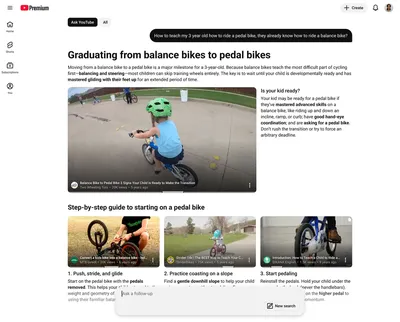
Google announced “Ask YouTube”, a feature that reimagines how people find and consume content on the platform. Rather than returning a list of video results, “Ask YouTube” provides a conversational, AI-generated answer to your question, surfacing the most relevant videos and jumping directly to the specific moment in a video most relevant to what you asked.
Google is beginning to test “Ask YouTube” now, with a broad US rollout planned for this summer.
The implications for charities and nonprofits
For charities that have built up YouTube libraries, “Ask YouTube” is both an opportunity and a prompt to audit. If your videos are not chaptered, or lack accurate transcripts and clear segment titles, Ask YouTube may surface another organisation's content in response to a query that your video could have answered. A well-structured video featuring a personal story or an expert explanation is exactly the kind of trusted, specific content that AI is likely to surface.
This connects to a broader shift worth taking seriously: social search. Platforms like TikTok, Instagram and YouTube are already where many people, particularly younger audiences, begin their search journeys, and Google is increasingly pulling this content into its own results. “Ask YouTube” accelerates this further.
If your charity hasn't yet considered social search as part of your visibility strategy, now is a good moment to start. We've written more about this in Five ways charities can remain visible in the changing digital landscape.
4. “Information Agents” Arrive in Search
Google has also announced the introduction of “Information agents”, which will launch first for Google AI Pro and Ultra subscribers this summer.
Information agents are personalised AI systems that users can configure within search to run in the background 24/7, continuously monitoring the web and delivering synthesised updates when something relevant happens.
A user could instruct an agent to monitor the latest updates on a certain global emergency or crisis, or track clinical trial developments for a particular condition. The agent scans blogs, news sites, social posts and real-time data to deliver a summary directly to the user, without them ever performing a search.
The implications for charities and nonprofits
This is zero-click search taken to its extreme. If an agent is delivering synthesised answers directly to users, the click to your website may never happen, even if your content was the primary source the agent drew from.
The flip side: for organisations whose content is authoritative and well-structured enough to be consistently cited, this is a new kind of visibility. Being the source that an information agent relies on may become a new visibility metric. The challenge may become how to track this.
A person newly diagnosed with a condition, or caring for someone who is, might set up an information agent to monitor developments. If that agent is drawing from NHS pages, Wikipedia, and major news outlets, then specialist health charities (who often hold the most nuanced, community-grounded knowledge) risk being bypassed entirely, unless they are quick to publish information about the developments.
5. Search Can Now Build Interactive Experiences on the Fly
Search can now generate entirely tailored, interactive interfaces in real time in response to a query.
Google demonstrated this live: a user asks "How do black holes affect spacetime?" and receives an interactive visual in an AI Overview. Ask a follow-up question and the system dynamically generates entirely new visuals in real time. This is made possible by "a novel real-time code generation system" built in partnership with Google DeepMind, running on Gemini 3.5 Flash. These generative UI capabilities roll out to everyone this summer, free of charge.
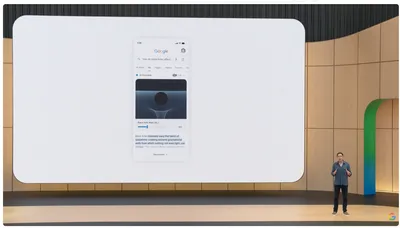
A presentation stage where a large screen shows a mobile Google search result for "how do black holes affect...". The "AI Overview" features an interactive 3D visual of a black hole warping a grid, complete with a adjustable "Black Hole Mass" slider and explanatory text. A presenter stands on stage to the right of the screen.
Google I/O '26 Keynote
The SEO implication for charities and nonprofits
This is the moment Google begins generating the kind of content that publishers, charities and specialist organisations have spent years building. If someone searches for symptoms or treatment information related to a health condition, and Search builds them an animated, interactive explainer in real time, their reason to visit a charity's website diminishes, even if that charity's content team spent months producing the most trusted version of that information.
This is especially challenging for health information charities, whose entire content strategy may be built around exactly these kinds of condition-led explainer pages.
Organisations whose content strategy relies heavily on "what is X" or "how does Y work" explainer content need to think hard about what they offer that an AI-generated page simply cannot: lived expertise, personal testimony, community, trust. That is where differentiation now lies and these are the things that should now sit at the heart of your content strategy.
6. Gemini Spark: A 24/7 Personal AI Agent
Gemini Spark is a new AI agent built into the Gemini app, running on dedicated virtual machines in Google Cloud 24 hours a day. It integrates with Gmail, Google Docs, Calendar and other Workspace tools, and will soon connect to third-party apps via MCP, including services like OpenTable, Spotify and Uber.
Spark can draft emails, assemble documents, monitor inboxes, automate repetitive workflows, and eventually make purchases on your behalf. It is designed not just to respond when prompted, but to proactively manage tasks over time.
It launches in beta for Google AI Ultra subscribers in the US next week, with broader rollout to follow.
The implications for charities and nonprofits
As Gemini Spark integrates with third-party platforms, it will increasingly mediate how users discover organisations, products and services, in a way that has nothing to do with search rankings. When someone asks Spark "find me a charity to support after the earthquake in Turkey," Spark will make a recommendation.
This has serious implications for emergency fundraising. During a disaster appeal, the organisations that Gemini Spark surfaces could shape donation behaviour at scale.
There's a parallel challenge for service-delivery charities. When someone asks Spark 'find me a food bank near me' or 'I need help with my mental health, what are my options?', the answer they get may determine which organisation they turn to.
What Do The Announcements at Google I/O 2026 Mean for Charities and Nonprofits?
The announcements at Google’s 2026 I/O are a continuation of the shift to AI, which we have been following for the past three years.
The organisations best placed to thrive in this developing landscape are not necessarily the biggest, but the most trusted: charities and nonprofits with genuine expertise, authentic community voice, and content that reflects real human experience. AI can synthesise information, but it cannot replicate the specific knowledge that comes from decades of working directly with a community.
Here are some practical next steps:
- Audit your visibility in AI Google Search results
- Structure your content and video for AI consumption
- Invest in owned channels that do not depend on Google, and double down on the depth and authenticity that makes your organisation’s offering irreplaceable.
Charities and nonprofits that approach this moment with curiosity rather than anxiety, and that start adapting today rather than waiting to see what happens, will be better positioned than ever to reach the people who need them most.
Let's discuss the impact of these developments for your charity.
Olivia-Mae Foong SEO Consultant
Get in touchMore
-

Build, buy or partner? Takeaways from our Charity Leaders' Breakfast
Lisa Ballam Marketing Director, Trustee Director
-

To buy or to build, and what should be considered in the procurement process
Dan Braghiș Staff Engineer & Tech Lead (Public Sector)
- See more posts