
AI: From strategy to action
How do you prove AI is working when efficiency targets drive the wrong behaviour? What do you do when your staff are already using AI tools you haven’t sanctioned? And how do you make a confident investment decision in a landscape that changes every month?
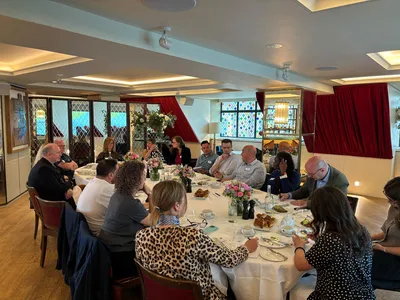
These were some of the questions that came up at our second Charity CEOs Breakfast at The Ivy Club. As with our first event in January, the conversation was remarkably open and honest.
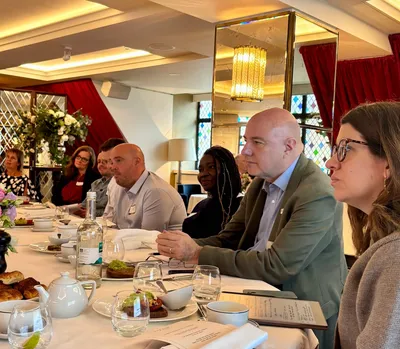
Leaders from RSPCA, Cancer Research UK, Mind, Samaritans, RNLI, St John Ambulance, Cats Protection, Tearfund, RNID, Art Fund, Drinkaware, Medical Aid for Palestinians, Alzheimer’s Society and Islamic Relief UK joined us around the table.
The organisations around the table varied hugely in sector, size and focus, from those with thousands of staff and volunteers to smaller, more specialist teams. Yet what was reassuring, was how similar the challenges and questions were regardless of sector or size.
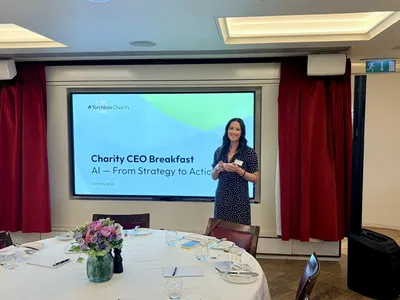
Where organisations actually are
When we asked everyone to introduce themselves and describe where they are with AI, nobody claimed to have cracked it. Some have governance frameworks and AI policies in place and are rolling out tools like Copilot, but haven’t yet moved into larger pilots or projects. Others described themselves as in the middle of a digital transformation marathon, carrying over a decade of technical debt while simultaneously being expected to modernise at pace.
The gap between having a policy and actually operationalising it is where most people are stuck. Policies need to be living documents that evolve alongside the technology, but translating good intentions into practical action is proving genuinely difficult.
Data before AI
You can’t talk about AI without talking about data, and this was one of the strongest themes of the morning. Several leaders described low data governance maturity as their biggest barrier, with critical organisational data stored inconsistently across multiple systems with no single view. One attendee described their data as the beating heart of the organisation, but acknowledged it was scattered everywhere and already out of date.
AI and data strategy need to be interconnected rather than treated as separate workstreams. Without strong foundations in data quality, governance, accessibility and infrastructure, AI adoption is built on sand, and for many in the room, getting the data house in order is the essential first step before AI can deliver on its promise.
Measurement and the board question
Leaders are increasingly being asked by their boards how they measure the success of AI, and most are finding that the obvious answer, efficiency gains, is both too narrow and potentially dangerous. Efficiency targets can drive the wrong behaviour, incentivising speed over quality or automation over thoughtfulness. But saying that AI makes things “better” without an objective way to describe what that means leaves boards understandably uneasy. Service delivery outcomes were seen as easier to measure than the impact on knowledge work, creativity, influence and strategic thinking, and there was real appetite for the sector to develop shared frameworks for measuring AI value that go beyond simple productivity metrics.
One framing that emerged was thinking about AI through three strategic lenses: impact, income and efficiency. This gave people a useful structure for anchoring investment decisions to mission, vision and strategic objectives rather than defaulting to productivity alone.
Build, buy or something in between
Many leaders leaned towards buying solutions, citing the weight of legacy systems, technical debt and limited internal capacity to maintain and evolve bespoke platforms. There was real anxiety about building something custom that gets left behind or becomes outdated within months in a landscape moving this fast. But others pushed back on the idea that this is ever a binary choice, arguing for a “configuration” approach somewhere between building from scratch and buying off the shelf. The challenge is making informed decisions in such a fast-moving space without deep technical expertise, and several people acknowledged they simply don’t know enough yet to make confident calls.
This connected strongly to collaboration. If the sector is collectively facing the same build versus buy decisions, there’s a major opportunity to pool resources, share approaches to tooling and governance, and avoid every organisation reinventing the wheel independently.
People, culture and the innovation divide
Every organisation in the room described some version of the same internal tension: AI advocates on one side, deep sceptics on the other. Navigating this is fundamentally a people and culture challenge, not a technical one.
Shadow AI is wrapped up in this too. Leaders want to avoid being overly restrictive, but many acknowledged they don't fully know what tools their staff are already using. Several are planning surveys to find out.
There were also some unexpected observations. Younger generations, rather than being the enthusiastic digital natives that organisations might expect, are showing increasing scepticism towards technology and taking deliberate breaks from social media. And as routine work gets automated, there's a real concern that employees are left with only the cognitively demanding or emotionally intensive work, potentially increasing pressure rather than reducing it.
Workforce planning and future roles
Leaders reflected on what future operating models might look like in an AI-enabled world. This isn’t just about upskilling existing teams but thinking carefully about what roles and capabilities organisations will need, including whether AI could eventually replace some higher-function roles, not just administrative ones, and what that means for workforce planning and restructures.
For organisations with large volunteer networks, the question takes on another dimension entirely. How does an organisation with 1,500 staff but 25,000 volunteers think about AI adoption across such a dispersed and varied workforce?

The outside-in view
The conversation repeatedly moved beyond internal adoption to consider the wider environment. Organisations are not just adapting to AI, they’re helping to shape the societal response around it. Disinformation and brand trust were major concerns, with leaders questioning the long-term implications of AI-generated content on supporter confidence, beneficiary trust and institutional credibility. There were questions about the authenticity of AI-generated images, the changing nature of online giving, and how agents are already being used in philanthropy. The charity sector was viewed as uniquely positioned to engage with these questions responsibly, precisely because of its relationship with vulnerable people and communities.
Responsible innovation, not reckless speed
Rather than racing to keep up with the pace of change, several leaders argued that there are genuine benefits to being deliberate and taking the time to get it right. One attendee made the case that being “flat-footed” isn’t always a bad thing if it means you avoid costly mistakes. At the same time, there was agreement that disengagement is not an option. The technology is here to stay, even if the hype bubble has burst, and organisations that choose to wait for everything to settle may find the ground has shifted beneath them.
Everyone agreed, it’s less about rushing to use AI every day and more about having the right conversations, building the right foundations, and creating the conditions for responsible experimentation. Legal, compliance and governance teams were seen not as blockers but as essential partners, and designing with them rather than around them was seen as critical to making innovation work.
What’s next
Perhaps the most energising part of the morning was the appetite for collaboration. Every person in the room wanted to keep the conversation going, share what they’re learning, and explore where the sector might work together on shared challenges. There was interest in developing common approaches to measurement, pooling expertise on the build versus buy question, and creating spaces where leaders can continue to be honest about what they don’t know.
The morning proved once again that the most valuable thing the sector has right now isn’t a fixed strategy document. It’s the willingness to say “we’re figuring this out” and learn from each other in real time.
Looking for support with your nonprofit's AI strategy?
Lisa Ballam Marketing Director, Trustee Director
Get in touchMore
-
From AI's impact on search to its potential to transform how you work
Lisa Ballam Marketing Director, Trustee Director
-

Google's latest AI announcements: A roundup for charities
Louisa Howells Vessey Senior SEO Executive
-

Build vs buy in the age of AI for the nonprofit sector
Ivan Teage Founding Director, Harmonic Action
- See more posts