
Google's latest AI announcements: A roundup for charities
In Google’s latest AI announcements, a number of updates were introduced across search, productivity, health and app development. Here’s our round-up of the most notable, and why they matter if you work in the charity and nonprofit sector.
A note on Google's direction
Google has explicitly named healthcare, crisis response and education as priority areas for development in AI-powered search tools.
This is a clear signal that the sectors charities operate in are becoming a central focus for how search evolves. We can see these updates as part of a wider shift towards more relevant, user-focused and trustworthy content experiences.
For charities operating in these spaces, this signals that more AI-driven change in search is coming, making relevant, helpful content more important than ever.
Search Live is now available in over 200 countries
Search Live, which lets users search using their voice or camera feed in real time, has expanded everywhere that AI Mode is available, which is approximately 200 countries and territories.
It's designed for hands-free, back-and-forth conversations with Search. This is ideal for solving problems, getting directions, or identifying an object while you're on the move.
The expansion of Search Live and AI Mode globally means voice and conversational searches are becoming more popular, reinforcing the value of content that answers real questions clearly and directly.
For charities covering health, financial support or crisis services, this is particularly relevant, as people increasingly look for immediate, practical answers in moments of need.

Gemini is getting deeper into Google's productivity tools
Google has expanded Gemini's functionality across Docs, Sheets, Slides and Drive, though currently this is limited to AI Ultra and Pro subscribers.
The most notable development is in Sheets, where Gemini is being positioned as a collaborative partner for complex data analysis.
Gemini can now also pull together insights from your files, emails and the web to help produce more in-depth documents. For teams already using Google Workspace, this could speed up research-heavy tasks and streamline internal processes.
Ask Maps: conversational search comes to Google Maps
Google Maps has been updated with a Gemini-powered conversational search feature called ‘Ask Maps’.
Rather than searching with simple keywords, users can now ask questions like "where can I charge my laptop and get the best coffee?" and receive relevant suggestions.
This reflects a broader shift towards more personalised, intent-driven search experiences, where users expect platforms to interpret context and provide tailored recommendations.
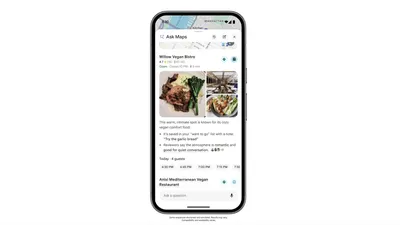
(Credit: Google)
Personal Intelligence: what it is and when it might reach the UK
Personal Intelligence is one of Google's more significant recent developments. The feature connects AI Mode in Search to a user's Gmail inbox and Google Photos library, allowing it to deliver highly personalised results without the user needing to provide additional context.
For example, it can reference hotel bookings in Gmail and travel memories in Google Photos to suggest a personalised itinerary.
This feature is currently only available in the US and is strictly opt-in for personal Google accounts. A wider international rollout is expected throughout 2026, but no specific UK launch date has been announced.
Image search is getting smarter
Google can now break down and search for multiple objects within a single image simultaneously.
Previously, visual search was a one-item-at-a-time process. Now, AI Mode can identify and search for multiple elements at once, and return a single, coherent response.
AI-assisted app building in Google AI Studio
Google has made it significantly easier to build apps, with prompts now being turned directly into production-ready apps via a new coding agent in Google AI Studio.
This lowers the barrier to entry for teams wanting to create simple tools or prototypes without needing a dedicated developer.
Health and Fitbit updates
At its annual health event, Google announced $10 million in funding to support organisations working to evolve clinician education in the AI era.
Fitbit is expanding its personal health coaching feature, with more personalised advice on sleep, health tracking, cycle health, mental wellbeing and nutrition. Users will also be able to connect their medical records directly to the Fitbit app.
What does this mean for the charity sector?
These announcements are significant, but the direction of travel is not surprising.
Google has been moving towards more personalised, AI-powered search experiences for some time, and its explicit focus on healthcare, crisis response and education is a clear signal that the sectors charities operate in are at the centre of that shift.
Organic search remains one of the most powerful traffic and visibility drivers available to charities, and that isn't changing. If anything, Google’s continued investment in these areas reinforces the value of what charities already do well, providing authoritative, trustworthy information to people who need it most.
Search is evolving quickly, but now is a good time to focus on the fundamentals and lean into your strengths, with clear, helpful content, a strong understanding of your audience, and a digital experience that supports people to find what they need quickly and easily.
Explore our charity SEO services if you need a quick site health check, some training and support or a complete SEO strategy.
Want to to chat through what these changes mean for your organisation’s search strategy?
More
-

The Charity Digital Skills Report 2026: in conversation with Zoe Amar
Lisa Ballam Marketing Director, Trustee Director
-

Charity social media in 2026: Insights from the Charity Digital Skills Report
Ashleigh Gall-Harper Senior Digital Marketing Executive
-

Charity lottery campaigns: what drives sign-ups, CPA and long-term value
Tanya Ellis-Puk Senior Digital Marketing Executive
- See more posts