
From AI's impact on search to its potential to transform how you work
For our latest Charity Leaders' Breakfast, we hosted our second AI Show and Tell.
We welcomed guests from charities including RSPCA, Breast Cancer Now, British Heart Foundation, Alzheimer's Research, Age UK, CRUK, Amnesty International, Marie Curie, Mind, MND Association, Prostate Cancer UK, RNID, Action for Children, Carers Trust, ActionAid, NSPCC, Kidney Care UK, Brain Tumour Research, Sue Ryder, St John Ambulance and more.
We had three presentations and as always they were practical, honest, and grounded in real work.
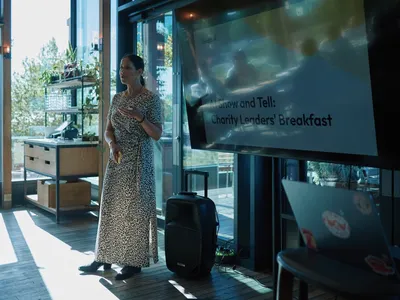
A quick introduction before getting started
What's happening to search — and why charities need to pay attention
Emma and Liv from our SEO team kicked things off with a look at what's actually been happening to organic search. Traffic has been falling where AI Overviews answer questions directly, and this has been going on for three years now. For health charities especially, that matters a lot, because Google's AI summaries have been shown to get health information wrong, and if charities aren't the source being drawn from, something less reliable will be.
But rather than just painting a gloomy picture, Emma and Liv were clear that there are real things charities can do. The first is to stop thinking about search in silos. Most charities have SEO, paid social, organic social and content sitting in separate teams with separate budgets, but your audience doesn't experience your organisation that way. Getting those teams collaborating around shared objectives is where the opportunity is, and that includes fundraising and events teams too, not just digital.
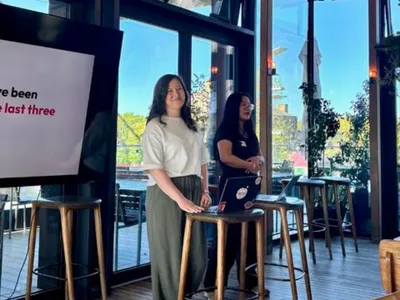
Emma and Liv unpack what’s really happening to search
The second is to think carefully about your content. Most charities have thousands of pages on their websites, a lot of which get very little traffic and are expensive to maintain. The question isn't whether you should have content, it's which content is worth the investment, and how do you make sure it's the content that AI is drawing from when people ask health questions. For health charities especially, demonstrating authority matters: clear review dates, trusted information marks, and structured data all help signal to search engines and AI tools that your content is the reliable source.
And it's not just Google. People increasingly discover charities and fundraising ideas through TikTok, Instagram, YouTube and Reddit, so channel diversity is becoming as important as SEO itself. The charities with strong content and a presence across multiple channels are much better placed than those relying on organic search alone.
The message wasn't "do more SEO." It was: treat discoverability as an organisation-wide concern, be honest about what you're maintaining and why, and make sure your paid and organic teams are talking to each other.
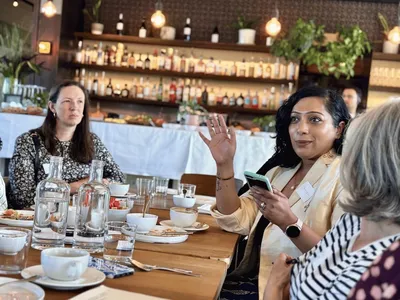
Dhanya Nair, SEO Lead at NSPCC chats with other guests
Art Fund: helping members find what they actually want to see
Mike Keating and Robin Clark from Art Fund, joined by Lizzie Wrobel and Tom Dyson from Torchbox, shared how they built an AI-powered cultural curator to help their 148,000 National Art Pass members discover museums, exhibitions and events that are actually relevant to them. With over 1,650 listings on any given day and no realistic way for a small team to make personalised recommendations at scale, they needed a different approach.
They started with a discovery workshop, six people from across the Art Pass product, including junior colleagues, and focused on two specific audiences: under-30s and families. That framing made all the difference, because they were solving a real problem rather than exploring a technology.
Tom demoed the prototype and walked through some of the practical detail behind building it, testing different models to find the right tone, language and cost; setting guardrails to prevent misuse; and the craft of prompting, including knowing when to use capitals to make a rule stick, like NEVER suggest a venue that isn't in the provided data. He also talked through the difference between deterministic and non-deterministic outputs, and why that distinction matters when trust is on the line. Three rounds of iteration, built on an existing data feed and deliberately kept lightweight to maintain momentum. A beta version launches on the Art Fund website in June or July.
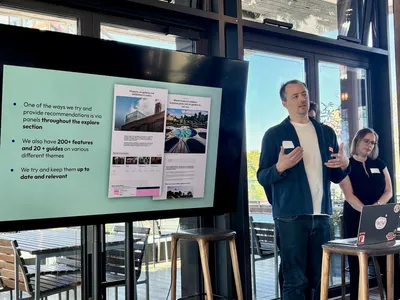
Art Fund sharing how they’re using AI to help members find museums and exhibitions
DEC: making quality control faster when every minute counts
Natasha Tierney from the Disasters Emergency Committee, with Iona Twiston-Davies from Torchbox, brought a very different use case and compelling arguments for starting small.
When the DEC launches an emergency appeal, everything has to move fast. Content comes in from across 15 member charities via Google Docs, email, all sorts of formats, and every piece needs checking against brand guidelines and appeal-specific wording rules that change with every crisis. That review process sat with one person, under intense pressure, with no consistent workflow.
The solution wasn't to get AI writing the copy. It was to use AI to support the proofreading, catching inconsistencies, flagging issues, keeping humans in the loop while removing a genuine bottleneck. It was chosen as the first pilot because it was contained, testable, and tied directly to something the organisation actually needed: being ready to launch the right appeal at the right time. The pilot results were hard to argue with. Every user found it valuable, every user mostly trusted the suggestions, 73% would keep using it, and 64% reported working faster.
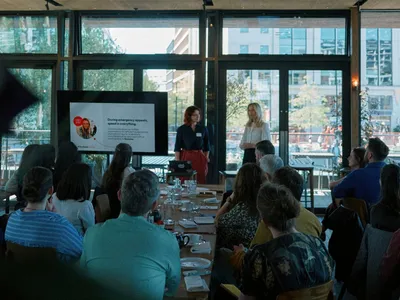
Iona and Natasha on using AI to support quality control during emergency appeals
What I took away
I really appreciate how honest our presenters are at these events. Everyone shared not just what worked but the thinking behind the decisions they made, and what they learnt, and that's what makes it genuinely useful for everyone in the room.
The thread running through both pilot projects was the same: start with a real problem, move to a prototype quickly, involve the people who'll actually use it, and treat governance as part of the work, not a box to tick at the end. Neither of these was a big-budget, multi-year effort. Both were scoped carefully, built fast, and iterated with real users.
What also came through clearly is that AI doesn't need to be scary. It's just another tool to draw on when you're trying to solve a problem, and sometimes the answer is AI, and sometimes it isn't. Both projects started by asking what the problem actually was, and only then worked out whether AI was the right way to tackle it. That's exactly the right order to do things.
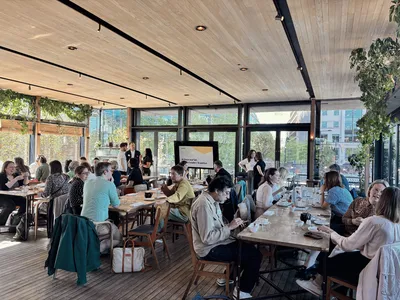
A sunny, bustling room at The Lighterman
If you'd like to join a future session, or want to talk through what a first AI project might look like for your organisation, get in touch.
Lisa Ballam Marketing Director, Trustee Director
Get in touchMore
-

How to recruit volunteers: A practical guide for charities
Danielle Wilkin Senior Digital Marketing Executive
-
The Charity Digital Skills Report 2026: in conversation with Zoe Amar
Lisa Ballam Marketing Director, Trustee Director
- See more posts