
What our research for Amnesty International UK can tell us about how people take action online
We recently designed and built Amnesty International UK's new website and knowledge hub, created to support their 2022–2030 strategy and help grow the human rights movement across the UK.
To make sure the platform was shaped around real needs and behaviours, we carried out qualitative research to understand how people discover, engage with and take action on human rights issues. We spoke with 20 people with varying relationships to Amnesty and human rights work, including long-standing volunteers, casual supporters, educators and people involved with other organisations.
The findings shaped the platform we designed and built, but many of the patterns we uncovered are relevant well beyond Amnesty. If your organisation relies on petitions, email actions, peer-to-peer sharing or mobilising supporters around campaigns, there's a lot here that will resonate, and hopefully challenge some assumptions about how people actually participate online.
Much of the activism people described was not loud or publicly visible. It often happened quietly, like signing petitions, sharing information with friends, or taking small actions that fit around everyday life. Others highlight quieter behaviours that are easy to overlook. Taken together, they offer a useful lens for any organisation working in campaigning, advocacy or movement-building.
Here’s what stood out from the research.
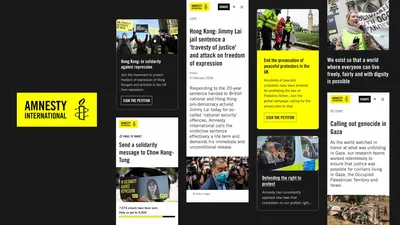
Screenshots from Amnesty International UK's new website
People rarely start their journey on the homepage
Most participants didn’t begin their journey by navigating directly to Amnesty’s website. Instead, they arrived through Google, email or social media, often in response to a specific issue or moment.
Usually I just Google it… I don’t go straight to the website.
This is something we see consistently across the charity and NGO sector. People don’t tend to follow neat, linear paths. They arrive with intent, often mid-journey, and expect to quickly find what they need. Even participants who knew specific content existed on the site would search for it externally rather than navigate to it.
If you’re trying to drive action online, this shifts the focus away from homepage-first thinking. Entry points are distributed, and journeys need to work wherever people land.
In practice, that means prioritising:
- strong SEO and discoverability
- clear pathways from content into meaningful actions
- making it easy for people to pick up a journey wherever they enter the site
Low-friction actions are far more likely to convert
Participants consistently described completing quick, mobile-friendly actions such as signing petitions or making donations.
Signing petitions and writing to members of parliament... it only takes a moment of time, and that doesn't really feel like a burden to me.
These actions were most successful when they included:
- a strong emotional hook
- a clear explanation of impact
- a simple next step
When those elements were missing, motivation often dropped away quickly.
The research also surfaced an important nuance: for some people, these small digital actions are their primary form of activism.
For teams planning campaigns, this shifts how low-friction actions are understood. They are not just a stepping stone to deeper engagement, but a valid and important form of participation in their own right.
Digital participation makes activism more accessible
For some participants, particularly those with health conditions or access needs, digital participation provided a way to contribute without needing to attend physical events.
Often we get left out because we can't make meetings… or because we have disabilities… and I don't think that's fair.
This highlights that digital participation is not just about convenience. For some, it is what enables participation in the first place. It also underlines the need to design for a broad range of needs and recognise that quieter, desk-based actions are a vital part of how people engage. Accessibility is fundamental to participation, and for some, digital channels are the primary way they are able to take part.
Organisational structures are not always clear, or important, to supporters
This is consistent with patterns we've seen across research for other large international NGOs. When an organisation has multiple entities, brands or layers, users struggle to distinguish between them. They are focused on completing a task, not understanding internal structures, so clear navigation, contextual information and strong search functionality is critical.
I wouldn’t know the difference between the UK site and the international one… I just look for the information I need.
People stay engaged when their actions feel meaningful
One of the clearest findings was how important recognition and feedback are.
Participants said they were more likely to stay involved when they could see:
- what their action contributed to
- what changed as a result
- what they could do next
If there was some kind of way of tracking it… like a Spotify Unwrapped, but for activism… I would love that.
This points to a real opportunity for organisations running ongoing campaigns. Showing impact, even in small ways, can help people feel part of something bigger and encourage continued participation. When people can see the difference they are making, they are more likely to come back and do it again.
Warm supporters behave differently to new audiences
The research revealed clear behavioural differences between existing supporters and new audiences.
External participants often engaged reactively, prompted by emotional content they encountered on social media.
Existing supporters behaved differently. They tended to:
- engage more intentionally
- actively search for resources
- contribute repeatedly over time
This is a pattern we see across the sector, and it has real design implications. Rather than building a single journey, organisations benefit from creating different entry points depending on intent. What works for a new audience discovering you for the first time is not always what keeps long-standing supporters engaged.
Private sharing is more common than public posting
A consistent pattern in the research was how frequently participants shared content privately rather than publicly.
Instead of posting on social media, many participants preferred to send content through:
- private group chats
This was especially true for politically sensitive issues, where people felt uncomfortable sharing publicly but were still motivated to discuss or recommend content within trusted networks.
If your strategy relies on people spreading the word, this has clear implications. Sharing does not always happen in public, so experiences need to support peer-to-peer sharing as well as visible amplification.
Many people do not see themselves as “activists”
Several participants described taking meaningful actions such as signing petitions, sharing information and attending events, but still hesitated to describe themselves as activists.
I wouldn’t call myself an activist… but I do sign petitions and things like that.
For some, the word “activism” suggests protests, expertise or high levels of commitment. This creates an opportunity to broaden how activism is framed, helping more people recognise that small actions can still contribute to meaningful change. It also points to a gap between behaviour and identity, where people may already be contributing without seeing themselves as activists.
Belonging comes from people, not just causes
Participants who felt most connected to Amnesty often had personal connections to others within the movement, whether through local groups, educator networks or digital communities. These relationships helped create a sense of belonging that sustained engagement over time.
You can't just push forward technology-wise and say ‘digital is our future’... when you're leaving so many people behind… I just want to belong. I just want to be part of something.
This is a reminder that digital platforms are not just about content and actions. They also play a role in connecting people to each other. For organisations building movements, that sense of connection between supporters can be just as important as their connection to the cause itself.
Clear, contextualised content helps people stay engaged
Participants frequently said they switched off when content felt overwhelming, overly technical, or full of insider language and acronyms. They engaged more with content that was written in plain language, clearly structured, and connected to a clear next step.
For organisations working in complex areas like human rights, this is a key consideration. Clarity does not reduce complexity, it makes it possible for more people to engage with it.
Designing digital platforms that support participation
Taken together, these insights helped shape the thinking behind the platform we designed and built for Amnesty International UK. The goal was not simply to build a website: it was to create a digital infrastructure that supports participation in many different forms, from quick online actions to deeper involvement over time.
We’re sharing these findings because many charities face similar challenges around engagement, participation and supporter journeys, and understanding real user behaviour is often the first step towards improving them.
If your organisation is trying to better understand supporter behaviour, improve digital journeys or increase meaningful action online, user research can help uncover where the biggest opportunities lie.
If you'd like to talk through how user research could support your website, campaigns or supporter journeys, get in touch.
Cassandra Christodolo Senior User Researcher
Get in touchMore
-

How to recruit volunteers: A practical guide for charities
Danielle Wilkin Senior Digital Marketing Executive
-

The Charity Digital Skills Report 2026: in conversation with Zoe Amar
Lisa Ballam Marketing Director, Trustee Director
- See more posts