
How humanitarian networks share knowledge at scale, and what charity digital teams can learn
The Start Network brings together 140 non-governmental organisations across six continents, ranging from large international organisations to local and national NGOs. Together, they coordinate humanitarian responses, share knowledge and act quickly in times of crisis.
We worked with Start Network to explore how its global network collaborates, communicates and shares knowledge in time-critical environments. This included interviews and surveys with participants from organisations across the UK, Bangladesh, Pakistan, the Philippines, Kenya, Palestine and India, spanning a range of roles, organisational sizes and regional contexts.
The research was used to inform recommendations for Start Network’s member platform, but the findings also highlight patterns that will feel familiar to organisations working across distributed, global teams or complex partnerships.
If your work depends on people sharing information quickly, making decisions under pressure, or coordinating activity across distributed teams and regions, there is a lot here that may resonate.
Here’s what stood out from the research.
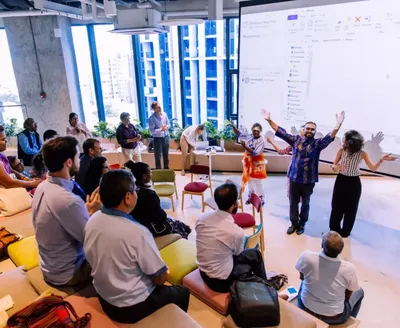
Start Network conference
Credit: Start Network, 2019
Shared knowledge needs structure to be useful
One of the clearest themes in the research was the importance of making knowledge easier to surface, reuse and apply.
Across the network, Skype played an important role in day-to-day communication, particularly for quick updates and coordination. But participants also described how the volume and pace of messages could make it difficult to identify the information that really mattered.
[When] there’s a training going on… you get 140 messages, and you’re like ‘is there a massive crisis going on?’... no, it’s just an update [in the Skype channel].
Valuable insights, case studies and learnings existed across the network, but were often spread across different tools, conversations and individuals, including training materials and experience from previous responses.
There are many things happening in many parts of the world, but they’re kind of fragmented… they’re not yet put together in such a way that could create a really strong [information base].
This points to a wider lesson for organisations working in fast-moving environments. Conversation is essential, but it does not automatically create shared knowledge. If important information lives inside busy threads or scattered sources, it becomes much harder to access and apply in the moments that matter.
Rather than replacing existing communication tools, the opportunity is to support them with more structured ways of capturing and sharing knowledge. A centralised knowledge hub can bring together summarised context and learnings, recorded webinars, training materials and searchable resources, making it easier for people to draw on what already exists.
There is also growing potential for AI to support this process. In fast-moving environments, it can help extract key information from busy conversations and move it into more structured, usable formats, making it easier to surface what matters and connect it to the right place.
Knowledge becomes much more valuable when it is not only shared, but structured in a way that helps people use it.
To work globally, you have to meet people where they are
Another strong finding was that communication habits varied widely depending on context.
Participants in the Global South described relying heavily on mobile devices and messaging apps, often moving between tools like WhatsApp, Viber and Telegram depending on need.
Mostly I use the phone… sometimes I use the desktop or the laptop.
Participants in the UK, by contrast, tended to prefer desktop-based tools and more formal channels, often because they did not have dedicated work phones and wanted clearer boundaries between work and personal life.
I would not opt into a WhatsApp group… I don’t have a work phone… it would mean that our private phones would just constantly blow up with messages.
The research highlights a tension many organisations will recognise when working across regions. Global networks operate across very different contexts, and digital systems need to reflect that. This is especially important when you consider device access and connectivity. During emergencies, communication may be restricted to SMS and satellite phones, which means essential messages need to be accessible offline and in text-based formats. Designing for mobile-first use, offline access and low data environments is essential if systems are to work across the full network. There is also an opportunity for AI to support this, helping to translate, summarise or reformat information so it can be accessed in low-bandwidth or text-based environments.
For organisations coordinating activity across regions, this is a useful reminder. Standardisation can only go so far. The strongest systems are often the ones that work with existing behaviours and constraints, rather than trying to flatten them.
Consistency matters more than novelty
Despite the wide range of tools in use, one channel stood out as universal.
Email emerged as the only consistently used communication tool across participants and regions. It was seen as reliable, appropriate for formal updates, and accessible in a way that other tools were not always able to match.
We are communicating very smoothly through emails with our donors.
While it may not be the most innovative tool, its consistency makes it an important foundation for communication strategies. Regular email updates can also play a role in promoting new resources, highlighting valuable contributions, and encouraging participation in shared platforms or knowledge hubs.
This is a useful lesson for organisations thinking about collaboration and engagement. Newer tools do not always replace older ones. In distributed networks especially, consistency and shared understanding often matter more than novelty.
The most effective communication ecosystems tend to build on what people already use and trust.
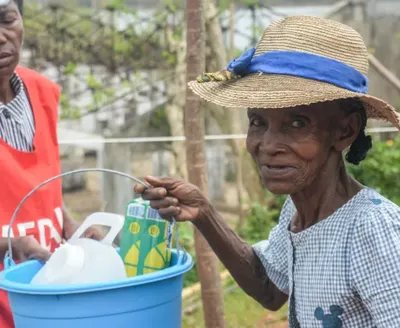
Emergency Response following Batsira and Emnati Cyclone in the southeast of Madagascar.
Credit: Medair, 2025
Better visibility makes collaboration easier
The research also highlighted the importance of making it easier for people across the network to identify and contact one another directly.
Several participants said a membership directory would be highly valuable, particularly when they needed to connect with people in specific countries or organisations and did not already know them personally.
[It would be great] to know the Start Network colleagues that are in-country that we can reach out to, who maybe have more in-depth information rather than having to go through the HQ level.
In many organisations, collaboration depends heavily on existing relationships. That works up to a point, but it becomes harder to sustain as networks grow.
Providing a clear view of who is in the network, what they do, and how to reach them can make a significant difference. A well-structured membership directory helps reduce reliance on central coordination and makes it easier for people to connect directly when it matters.
For organisations working across partnerships, regions or communities of practice, this is a helpful takeaway. Knowledge sharing is not only about content. It is also about helping people find the right person quickly, without unnecessary layers of coordination.
New platforms only work if they fit how people already operate
The research also surfaced an important point about adoption.
Start Network’s existing member portal was designed to support collaboration and resource sharing, but participants described varied levels of awareness and usage. Some were unaware of it, while others relied on colleagues to use it on their behalf.
I’m not using the [member portal]... one of our assigned colleagues [is] responsible [for that].
Where it was used, it was mainly for specific tasks such as accessing training or updating organisational details, rather than acting as a central hub for collaboration.
This reflects a wider pattern. Platforms are most effective when they align closely with existing behaviours and offer clear, immediate value. If they sit outside day-to-day workflows, they are less likely to become part of how people work.
That’s why testing and iteration are so important. Exploring technical approaches, prototyping ideas, and testing with real users helps ensure that any new platform or feature supports how people work, rather than adding another layer to navigate.
Collaboration at scale needs systems that complement each other
Taken together, the research points towards a broader lesson.
The challenge is rarely a simple lack of tools. More often, it is about how tools, information and workflows fit together. Fast-moving conversations are useful for coordination. Email provides consistency. Different regions rely on different devices and channels. Valuable knowledge already exists. The opportunity is to create infrastructure that helps those things work together more effectively.
Rather than replacing existing tools, the most effective approach is often to complement them. Bringing together fragmented information through a central knowledge hub, supporting communication through consistent channels like email, and making it easier for people to connect directly can all help strengthen collaboration across a network.
For organisations working across time-critical, multi-stakeholder environments, that feels like the clearest takeaway. Effective collaboration depends on more than communication. It depends on creating systems that make knowledge usable, connections easier, and participation possible across different contexts.
If your organisation is thinking about how to improve collaboration, knowledge sharing or coordination across distributed teams, these are useful questions to ask:
- Where does critical knowledge live today?
- How easy is it to access and act on?
- Which tools are already working well, and how could they be better supported?
- How well do your systems reflect the realities of the people using them?
- Where could AI help make complex or fast-moving information easier to access and act on?
Working with Torchbox on this research gave us a really strong foundation to build from. It ensured we were not designing in isolation, but instead grounding every decision in the experiences of our members: from local to global humanitarian organisations. This has resulted in a member community platform that is flexible to different contexts and country needs, while bringing together over 140 organisations across six continents in a more meaningful and connected way.

Zofia Piotrowicz Digital Manager, Start Network
The new Start Network member community platform is now live and available for all member organisations and partners to join.
If this resonates, and you’re exploring how your own platform or network could better support collaboration at scale, we’d be happy to share more of what we learned from this work.
Looking to improve collaboration and knowledge sharing across your organisation?
Cassandra Christodolo Senior User Researcher
Get in touchMore
-

How to recruit volunteers: A practical guide for charities
Danielle Wilkin Senior Digital Marketing Executive
-

The Charity Digital Skills Report 2026: in conversation with Zoe Amar
Lisa Ballam Marketing Director, Trustee Director
- See more posts