
Charity lottery campaigns: what drives sign-ups, CPA and long-term value
Lottery campaigns are a familiar part of the fundraising mix for many charities, offering a simple way for supporters to give regularly, often for as little as £1 a week, with the added incentive of a prize.
But while the model itself is relatively simple, running a lottery campaign and getting it to perform well comes with its own set of considerations.
In this guide, we bring together insights from live campaign performance and wider sector learnings to explore how charity lottery campaigns perform in practice. We share some of the key patterns, challenges and opportunities we’re seeing, alongside practical considerations that can help improve sign-ups, CPA and long-term value over time.
How lottery campaigns fit into the fundraising mix
Lottery campaigns are often described as a form of regular giving, but with a slightly different value exchange.
Rather than simply donating each month, supporters enter a prize draw while contributing to a cause they care about. That combination can broaden appeal: for some, the motivation is the cause itself; for others, it’s the added incentive of winning.
This means lottery campaigns can play a few different roles:
- Attract new audiences who may not engage with traditional donation asks
- Provide an additional giving route for existing supporters
- Support awareness, particularly when promoted at scale
They’re widely used across the sector, from health charities like Breast Cancer Now, to animal charities like Battersea, and humanitarian organisations like ActionAid.
What’s involved in running a charity lottery campaign?
While the front-end experience is straightforward, there’s more complexity behind the scenes.
Regulation and platform requirements
Because lotteries are classified as gambling activity, charities need:
- A valid Gambling Commission licence
- Platform-specific authorisation (e.g. Meta, Google, Microsoft)
- Clear licence visibility on landing pages
This can add time to campaign setup, particularly where approvals are required before ads can run.
In some cases, this becomes a limiting factor. Some smaller charities, for example, may only hold local licences, which aren’t always sufficient for advertising on major platforms.
Operational setup
Many charities work with third-party providers (such as Sterling or StarVale) to manage the lottery itself.
This can simplify administration, particularly around prize distribution, but it can introduce some constraints:
- Landing pages are often hosted on separate subdomains
- Design and user journeys can be fairly standardised
- Limited flexibility to optimise
- Attribution isn’t always straightforward, and reported performance can vary between platforms like Meta and GA4
As a result, performance often depends more on how campaigns are driven to these pages, rather than the pages themselves.
Accurate tracking is also critical. Ensuring pixels, conversion actions and UTMs are correctly set up from the outset makes it easier to measure performance and optimise campaigns over time. Where sign-ups take place across separate platforms or subdomains, agreeing a consistent measurement approach from the outset can help avoid confusion when comparing reporting tools.
Revenue considerations
Unlike other forms of fundraising, not all income from a lottery goes directly to the charity. A portion is allocated to prize funding. This means campaigns need to reach a sufficient scale in terms of subscribers to be sustainable over time.
Another point to consider is long-term player value. Although lottery CPAs can sometimes appear high at first, lotteries are a recurring revenue product, so upfront acquisition costs only tell part of the story. Campaigns that initially appear less efficient can still deliver strong long-term value through ongoing subscriptions and retention.
Clear upfront planning, including budgets, audiences and KPIs play an important role in how effectively campaigns can be managed and optimised over time.
Trends we’re seeing across campaigns
- CPA varies widely, depending on channel mix, audience and campaign maturity. There’s no single formula for success.
- The prize plays a central role in driving sign-ups. Creative that leads with what someone could win tends to drive a stronger response than cause-led messaging, with the cause often playing a more supporting role in the initial decision to sign up.
- Performance also tends to improve over time. New lottery campaigns often see higher CPAs early on, particularly when targeting cold audiences, with efficiency improving as awareness grows and more users begin actively searching for the product.
- Remarketing consistently delivers stronger results than cold targeting. Users who have already engaged, whether through social, search or site visits, are more likely to convert, particularly given the commitment of signing up to a recurring payment.
- Different channels tend to play different roles across the journey. Search often delivers some of the most efficient CPAs and strongest click-through rates, particularly when supported by upper-funnel activity.
- Timing can also have a noticeable impact on performance. Seasonal trends and shifts in supporter behaviour can influence both acquisition costs and conversion rates.
Case study: Breast Cancer Now
Breast Cancer Now’s Pink Ribbon Lottery is a well-established campaign. We’ve supported Breast Cancer Now with the paid media strategy, Meta campaign activity and creative development for six years, working closely with their team to test, optimise and evolve the campaign over time.
The campaign runs across Meta, Google Search and Performance Max, with ongoing optimisation and creative support.
Across the 2025–26 campaign so far, results include:
- £105k total spend
- 1,499 new players acquired
- £82 average CPA
- 68k+ clicks from 12.5k million impressions
At the end of 2025 and into early 2026, the account was impacted by Meta Pixel health restrictions, which affected optimisation performance, particularly within remarketing audiences. As a result, CPAs increased to around the £120 mark during this period.
Following the implementation of pixel workarounds and tracking improvements, performance has steadily recovered, with CPAs decreasing month-on-month. This highlights how important robust tracking is to maintain and improve campaign performance over time. It also suggests that sustained investment and optimisation can lead to more efficient performance as campaigns mature.
Read the full Breast Cancer Now Pink Ribbon Lottery case study.

Since Torchbox took over full management of our paid social lottery campaign, we've seen a significant reduction in our CPA, which has allowed us to gradually increase our spend without compromising ROI, helping us recruit more lottery players, and generate more sustainable income to fund our research and services.

Charlotte Wade Senior Manager, Lottery and Raffle
Case study: ActionAid
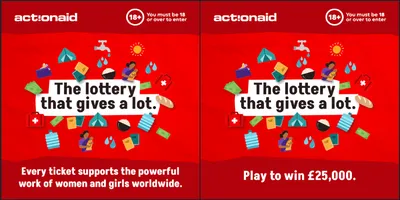
ActionAid’s lottery campaign offers a different perspective, focusing on the launch and growth of a new lottery product. We worked closely with the team across paid media strategy, campaign delivery and optimisation, helping to build awareness while driving acquisition from launch.
Running across Meta, Google Search and Performance Max, the campaign has focused on building awareness alongside acquisition.
Across Q1:
- £22.4k spend
- 269 conversions
- ~1.2% conversion rate
- ~£190 blended CPA
As a newly launched product, early performance was less efficient, with higher CPAs, while awareness was still building. Over time, results began to stabilise as more users became familiar with the lottery and started actively searching for it.
Channel performance has varied:
- Performance Max has delivered the most efficient CPAs at points
- Search has become more effective as awareness has increased
- Meta has driven reach and volume, but at a higher cost
The campaign also reinforced the importance of ongoing creative testing and iteration. Introducing new creative variations throughout the campaign helped sustain engagement and uncover fresh opportunities for performance, particularly on Meta.
Overall, the campaign reflects a common pattern for new lottery products: performance improves over time, as awareness builds and users move further down the funnel.
Torchbox played a key role in helping us bring the product to market, providing strategic guidance across paid media as well as the technical support needed to establish effective tracking, optimisation and reporting from day one. The expertise and support provided by the team have been significant contributors to the campaign's success to date, helping us build a strong foundation for future growth.

Peter Fabian Senior Digital Fundraising Acquisition Manager
Five things to keep in mind when running a lottery campaign
1. Lead with the prize
Creative that highlights what someone could win performs best.
Messaging like “win £25,000” or “turn £1 into…” tends to drive a stronger response than leading with the cause alone. The cause still matters and should be woven into the ad, but it usually plays more of a supporting role in the initial decision to sign up.
2. Don’t expect immediate efficiency
For new lottery products, performance can take time to build.
Early campaigns often see higher CPAs, particularly when awareness is low. As more people become familiar with the product, and start actively searching for it, results tend to improve.
3. Make the most of remarketing
Users who have already engaged are more likely to convert, making remarketing an important part of the overall channel mix rather than an afterthought.
4. Plan for peaks and dips in performance
Performance isn’t consistent throughout the year, or even the month.
CPAs often rise during busier periods like Christmas, while conversion rates can improve around payday. Budget pacing and timing can have a noticeable impact on overall results.
5. Keep creative fresh and constantly test
Creative fatigue can have a significant impact, particularly on paid social.
Campaigns with limited creative variation or infrequent updates often see performance decline over time. Putting a creative roadmap in place can help ensure assets are refreshed regularly.
In conclusion, lottery campaigns can be a valuable part of the fundraising mix, particularly when viewed as a long-term programme rather than a short-term acquisition campaign. The strongest results tend to come from ongoing testing, learning and optimisation over time.
If you’re exploring how lottery campaigns could fit into your fundraising mix, or want to build on what you’re already doing, we’d love to hear from you.
Looking to grow your lottery campaign?
We can support you to improve acquisition through paid media, search and creative optimisation.
Tanya Ellis-Puk Senior Digital Marketing Executive
Get in touchMore
-

The rise of social search: Latest updates for the charity sector
Laura Matthews Digital Account Manager
-

What the Charity Digital Skills Report 2026 tells us about the future of the sector
Phil McMinn Chief Strategy Officer (Charity Sector)
-

How charities can engage high-value donors in 2026
Marnie Winter-Burke Senior Digital Account Manager
- See more posts