
AI and strategic leadership: where are we now?
For our third Charity CEO Breakfast, we brought together guests from Age International, Alzheimer's Research UK, Alzheimer's Society, Action for Children, Breast Cancer Now, Diabetes UK, Freedom from Torture, Macmillan Cancer Support, Mind, MND Association, Women's Aid and Young Lives vs Cancer at the Ivy Club in Soho.
As always, the conversation was open and honest, and amazing progress is happening across the sector. The thing organisations are grappling with most, though, is how to measure the impact AI is actually making.
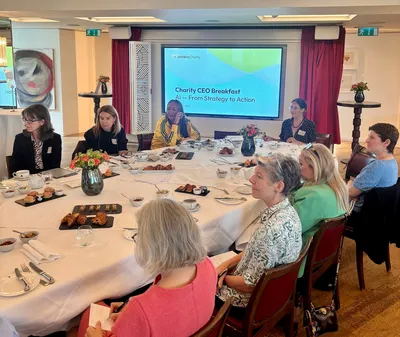
Kicking off the morning together, with a very lovely breakfast spread
Pride and progress
Organisations that were previously deciding whether to engage with AI now have the foundations in place, building ethics policies, launching pilots and restructuring data infrastructure. They've also found some unexpected champions along the way — frontline staff, including nurses, helpline workers and social workers, are often the most enthusiastic adopters of new tools, which surprised more than a few people in the room and will shape how they approach the next phase of their work.
AI is no longer a future question for most organisations. It's already embedded in the tools people use every day, whether that's Copilot, Salesforce, or something teams have quietly started experimenting with on their own. One guest put it well: using AI for daily tasks is no different to giving someone Microsoft Word or Outlook. It's becoming standard practice.
Measuring what matters
One question dominated the morning: how do you actually measure the impact of AI? Guests shared examples of time saved for staff — sometimes days rather than hours — but the conversation kept returning to what those savings are generating in terms of real impact.
Token usage will continue to climb, and investment in dedicated AI roles will push salary bills up, so organisations need to get clearer about the return that investment generates. There was broad agreement that it's easier to set meaningful KPIs for a defined AI project than for the day-to-day use of AI tools, and for most organisations the question of whose responsibility it is to track and report on impact remains unanswered.
Clinging on to critical thinking
Part of the discussion focused on AI's impact on critical thinking. One guest described being shown a beautiful set of slides that effectively said nothing and made no sense. Others shared experiences of the recruitment process being saturated with AI-generated applications that bear no resemblance to the actual candidate, and several flagged that the administrative burden around staff grievances and external legal challenges is growing because of AI-generated content. Building critical thinking and AI literacy into organisational culture is becoming as important as the technology itself.
"AI in the loop, not human in the loop"
I recently had a coffee with the lovely Cath Biddle, Director, Digital and Data at Breast Cancer Now, and she shared a reframe that it needs to be AI that’s in the loop, not human in the loop. So I decided to share this with our guests, which got a really positive reception and they all agreed that this is a really important shift in how we think about things.
It puts the human back in control and positions AI as the thing being supervised rather than the thing doing the supervising.
The data opportunity
For many organisations in the room, getting data right remains both a barrier and an opportunity. Inconsistent input from different teams, fragmented systems and poor data quality are not new problems, but the urgency to fix them has increased. Organisations that use this moment to get their data in order will be in a much stronger position to make AI work for them.
Two organisations shared similar experiences of adopting new data strategies and platforms that quickly became crippled by cost, and there was a debate about whether the big players, such as Salesforce, Oracle and others investing heavily in AI functionality, can ever truly answer the needs of the charity sector, or whether the same frustrations will follow organisations into shinier, more expensive tools.
A related point was raised about the attractive deals that big platforms like Microsoft offer charities to get everyone onto their ecosystem — but what happens when those costs inevitably go up?
Something special is building
What I love about these events is how much people value the space to be honest. Every organisation around the table is at a different stage, with different pressures, resources and risk appetites. But the questions are remarkably similar, and the willingness to share what's working, what isn't and what's keeping people up at night is what makes these mornings so valuable.
A real community of leaders is beginning to form — one that understands how challenges are evolving across the sector over time, not just within their own walls.
We'll be back together in January. If you'd like to join a future breakfast, let me know.
Leading on AI in your organisation? Join us at a future Charity CEO Breakfast to share what you’re learning with peers across the sector. Drop me a message on LinkedIn to join the guest list.
More
-
The Charity Digital Skills Report 2026: in conversation with Zoe Amar
Lisa Ballam Marketing Director, Trustee Director
-

The rise of social search: Latest updates for the charity sector
Laura Matthews Digital Account Manager
- See more posts