

Reflections from UK Gov Camp 2026
Last week, we headed to UK Gov Camp 2026 as a Gold Sponsor, which for the first time was held outside London, at Birmingham City Council House.
Birmingham’s role as a hub for both central and local government made it a fitting setting for a day shaped entirely by the people in the room. As ever, UK Gov Camp lived up to its reputation: open, community-led, and refreshingly honest.
Across the day, people shared challenges they’re facing, alongside examples of where individuals and teams are trying to improve how public services work. A few themes and ideas stuck with us. Here are some of the key takeaways we brought away.
Data sharing, and what gets in the way
One of the strongest and most widely shared topics of discussion was how difficult it still is to share data effectively across government.
This isn’t a new issue, but it came up in lots of different forms. People talked about how hard it remains for data to be shared, not just between departments, but also within departments.
This wasn’t framed as a lack of desire to improve things. The general sense was that most people working in and around government can see the value of better data sharing, particularly when it would make services easier for the public to use. Instead, the hesitation seems to come from concerns about consent, accountability, and what happens if something goes wrong.
High-profile data breaches in the private sector were often mentioned as part of the backdrop to that caution. While it’s crucial to protect privacy and ensure data security, we must also strive for innovation to improve public services.
Several conversations touched on the idea that clearer national direction could help here, not to remove local decision-making, but to take some of the personal risk off individual teams. If mandates for data sharing were set by the central government, it would be easier for civil servants to move forward without feeling they’re acting alone.
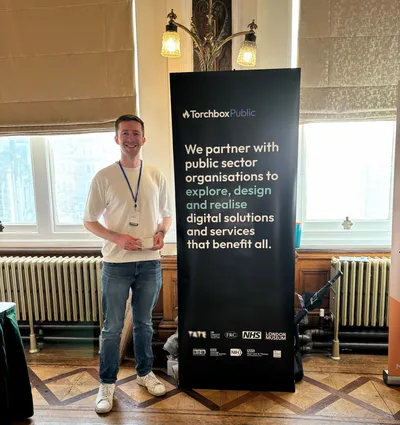
A quick snap of Mark in between sessions
Looking beyond the UK for perspective
International examples came up in multiple sessions, often as a way of widening the conversation rather than presenting ready-made answers. These examples weren’t presented as models to copy directly, but as prompts to think differently about what’s possible in different contexts.
Countries including Ukraine, Estonia, Taiwan, Moldova and India were mentioned for the way digital services have been designed and adopted at pace. In Ukraine’s case, the pressures of war have clearly accelerated change, leading to services that allow people to report property damage or access support through a single app.
At the same time, there was a lot of acknowledgement that context matters. Government services aren’t consumer products, and comparisons with commercial platforms only go so far.
There was also a recurring point about civic education. Even people working inside government often described systems as opaque and hard to navigate, which feeds into public frustration and unrealistic expectations about how quickly change can happen.
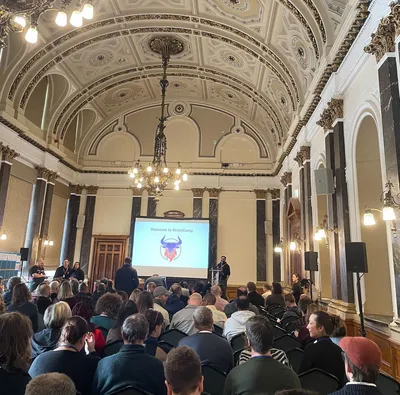
A packed room at UK Gov Camp
Procurement, timing, and outcomes
Procurement came up a lot too, particularly in local government, often as an area where existing processes make change harder than it needs to be.
Several people described a familiar pattern: service teams understand the outcomes they want, but procurement often enters the picture late, when contracts are expiring, and things are already on fire. With little time to explore alternatives, teams default to renewing or extending what they already have, often with the intention of fixing issues or adding features later, a moment that, in practice, rarely arrives.
There’s also a disconnect between service delivery teams and procurement specialists, which can result in the wrong questions being asked. Instead of framing procurement around outcomes and constraints, it can default to documents, templates and requirements that reflect how things were done last time.
Encouragingly, there were also examples of people actively trying to improve how procurement works in practice. Examples shared included work to modernise shared procurement language, including updating outdated vocabularies that don’t yet account for things like cloud services or AI, as well as growing interest in:
- more transparent tracking of spend
- better, shorter contracts with reusable elements (such as accessibility and security requirements)
- stronger communities of practice between government and suppliers (examples of this already happening include the Ministry of Housing, Communities and Local Government)
- clearer AI procurement frameworks
All of this points to a desire to make procurement a tool for better services, rather than a barrier to change.
Rethinking documents, data and “records”
Another group focused on how the government thinks about information.
Instead of centering everything on documents, often long PDFs that are hard to reuse or analyse, some conversations explored the idea of “records”: vehicles for conveying decisions or evidence, which don’t always need to exist as final paper artefacts.
Examples like power of attorney or a child’s vaccination record illustrated this shift. For many people, these already function as concepts rather than physical documents. Reframing information this way opens up possibilities for better interoperability, more structured data, and systems that can genuinely talk to each other.
This matters particularly in procurement, where vast numbers of documents often disappear into what can be described as “PDF purgatory”.
Being more honest about solutions
The tension between solution-led and problem-led thinking also resurfaced, but with a more nuanced take than simply “don’t solutionise”.
People acknowledged that coming with a solution is human nature. The challenge isn’t to shut that down, but to stay humble and curious: why does someone think this solution is needed? What problem are they really seeing? Is this the right response?
Rather than policing behaviour, several conversations focused on creating better spaces for idea review and discussion, welcoming people into the process instead of pushing them away.
Knowing when to stop
Related to this was a strong theme around Discovery and decision-making, particularly the importance of being more honest about when work should pause or stop altogether.
Several conversations touched on how Discovery can sometimes be scoped too broadly, or treated as a box-ticking exercise, rather than a chance to genuinely test whether a project should move forward. There was a shared sense that teams need more permission to say “no” or at least “not yet” when assumptions don’t hold up, especially after Discovery or early Alpha.
That includes being willing to revisit the original business case and to refine or rethink the brief based on what’s been learned. Rather than seeing this as failure, people talked about it as a sign of responsible decision-making, particularly in environments where time, budget, and trust are limited.
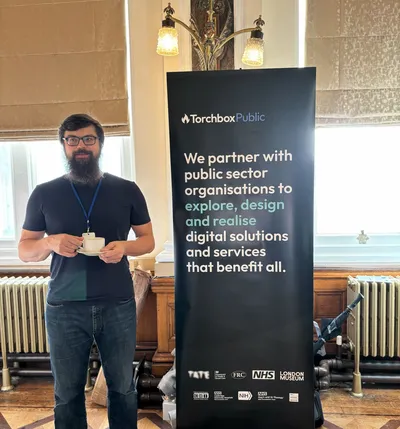
Dan stands alongside our Torchbox Public banner ☕️
Final thoughts
As ever, UK Gov Camp created space for honest conversations between people working in different parts of the public sector, in a setting without formal hierarchy or a set agenda.
The move to Birmingham felt like a positive step in widening that conversation, and we left with plenty to reflect on about trust, culture, and the small, practical ways people are trying to make progress in complex environments.
Thanks to the organisers, volunteers and sponsors who make UK Gov Camp possible, and to everyone who shared their experiences so openly throughout the day.
More
-

What could your team achieve with an AI co-investment?
Lisa Ballam Head of Marketing, Trustee Director
-
Eight considerations before launching a public-facing AI tool
Mark Boyle Client Partner (Public Sector)
- See more posts
