

Key insights from Public Service Data.AI conference
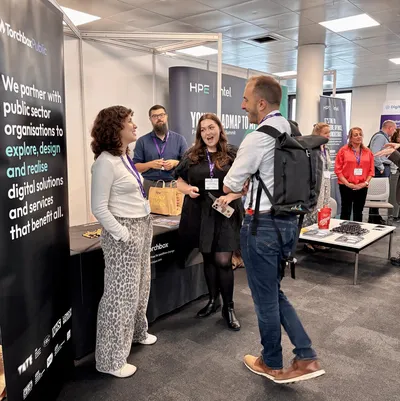
We attended the recent Public Service Data.AI conference as a speaker on the Impact Stage and took advantage of the opportunity to hear the excellent talks and speakers. Here are our takeaways and insights from the sessions we attended and the connections we made.
What we took away
The overarching theme was clear: the public sector is shifting from tentative experimentation to confident, strategic AI implementation. The conversations have evolved from “Should we use AI?” to “How do we scale AI responsibly?” Three key insights stood out:
- Governance frameworks are essential. Organisations succeeding with AI have clear policies and oversight structures in place before scaling.
- Cultural change matters more than technology. The biggest barrier is not technical capability but organisational change management.
- Collaboration accelerates progress. Sharing tools and approaches delivers better outcomes than working in isolation.
Setting the vision: Emily Middleton's opening keynote
Emily Middleton from GDS outlined an ambitious vision for AI across government. Key announcements included:
- A £42 million AI Frontiers Programme, focusing on horizontal solutions across government rather than isolated use cases.
- An AI accelerator for the civil service to build confidence in using AI among non-specialists.
- Expansion of Gov.uk chat and plans for widespread Microsoft Copilot deployment.
- Publication in October of a shared digital delivery plan to 2030.
The emphasis on “non-specialists engaging with AI” signals recognition that AI literacy needs to become as fundamental as digital literacy across the civil service.
Our contribution: Reaching the unreachable
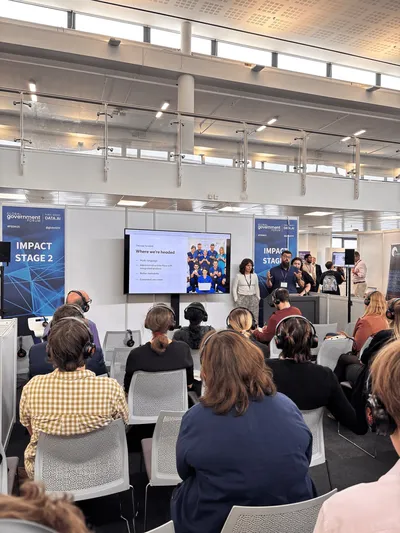
Together with Emma from Guy's and St Thomas' Hospital Trust Foundation, we presented “Scaling qualitative research with AI - Reaching the unreachable.” Our session explored how AI can transform research accessibility by engaging voices typically excluded from traditional research processes, and scaling insight beyond conventional constraints.
We received an enthusiastic reception to our talk and follow up discussions, which shows the appetite for AI solutions that prioritise human-centred design and ethical implementation, demonstrating that the best AI applications enhance, rather than replace, human insight.
From shadow IT to strategic governance.
Owen Hopkin from Arts Council England shared a journey many organisations will recognise. A staff survey revealed that 42% were already using AI tools – but in a “shadow IT” way that created significant compliance and reputational risks.
Their response was great: rather than restricting usage, they built a comprehensive governance framework with diverse stakeholder groups and accessible policies written in plain language. Their key insight? “AI policy is not an IT document – the entire organisation needs to be involved in developing it.”
They published their full framework and approach, demonstrating the value of working openly and consulting widely to move at pace whilst rooting decisions in organisational values.
Systematic implementation at scale
Ott Velsberg from Estonia showcased what strategic AI implementation looks like with over 200 active use cases:
- Predictive support. Identifying when individuals are likely to become unemployed, and what the risk that they might become long-term unemployed, enabling proactive intervention, with a human expert making the final decision.
- Resource optimisation. Using satellite data to identify which homes are more fire-prone and thus in need of inspection, and to classify farming land – from mowing to the crops being planted.
- Administrative efficiency. Automating 80% of briefing notes, to reduce an estimated 32,000 hours spent on producing the notes annually.
Their pragmatic approach to quality stood out. As Chief Government Data Officer, Ott Velsberg, noted: “We put much higher thresholds for AI tools than humans. We expect machines to be perfect. Ask yourself: what is good enough? What is the realistic threshold to reach?”
Estonia’s approach includes monitoring usage to understand whether low adoption reflects a lack of training or a genuine lack of need – ensuring resources are directed effectively.
Practical solutions: DSIT's consultation processing
The Department for Science, Innovation and Technology demonstrated how AI can address genuine operational pain points. With public consultations costing an estimated £80 million annually across government (individual departments spending £30–100k processing responses), their SIFT tool tackles a significant challenge.
The tool automates the extraction of structured information from free-text responses, with humans reviewing and accepting or rejecting suggestions. Crucially, they have open-sourced the solution on GitHub, showing how collaborative approaches can scale benefits across the sector rather than duplicating effort.
Key success factors: What works
Multiple speakers emphasised that technical implementation is only half the battle. The bigger challenge is organisational change management.
Clear patterns emerged for successful AI adoption:
- Start small, think strategically. Begin with practical, contained pilots while maintaining a strategic vision. Newcastle City Council’s journey from a 15-day tip signup process to 30-second automation exemplifies this approach.
- Establish governance before scaling. Organisations that struggled often tried to scale without proper frameworks. Those that succeeded had clear policies, oversight structures, and transparent decision-making processes in place from the outset.
- Secure executive buy-in or keep it small. Without leadership support, initiatives should remain practical and contained. It is also worth checking whether processes need changing before introducing new technology.
- Invest in training and buy-in. Tom Winstanley’s (CTO & Head of New Ventures at NTT Data) experience highlighted how technical solutions fail without proper training programmes and organisational support. The human element remains central to AI success.
- Collaborate rather than compete. The most successful implementations checked for existing tools and leveraged partnerships rather than building everything from scratch. Estonia’s collaborative approach offers a strong model for the sector.
- Set realistic quality thresholds. Do not expect AI to be perfect when humans are not. Ask what “good enough” looks like for your specific context, considering diminishing returns.
- Think about data first. High-quality data benefits both organisations and AI tools. Ethical considerations around experimentation, hallucinations, and cybersecurity should be addressed from the start.
Looking forward: Agentic AI and workflow transformation.
The conversation is shifting beyond simple automation towards reimagining entire processes. Several speakers discussed agentic AI and the need to rethink workflows, team structures, and how organisations engage with citizens.
The challenge highlighted repeatedly was that many pilots and prototypes stall because of a lack of pragmatic approaches to deployment at scale. Moving from proof of concept to production requires more than technical capability – it demands operational readiness and cultural change.
The path forward
The conference revealed a sector moving confidently from experimentation to strategic implementation. Success is not about having the most advanced technology but about having the clearest governance, strongest stakeholder buy-in, and most systematic change management approaches.
Key principles for organisations embarking on AI implementation:
- Start with governance frameworks that address both opportunity and risk.
- Focus on solving genuine business problems with measurable outcomes.
- Collaborate and reuse rather than building in isolation.
- Invest in comprehensive change management that addresses skills, workflows, and culture.
- Set realistic expectations about what AI can deliver and when.
The question is no longer whether to adopt AI, but how to do it responsibly, effectively, and at scale. The blueprint exists – now it is about execution and finding where to start.
Navigate complexity creatively
Our Possibility Mapping Workshop helps public sector teams align stakeholders and uncover practical opportunities for action.
More
-
What could your team achieve with an AI co-investment?
Lisa Ballam Head of Marketing, Trustee Director
-

Eight considerations before launching a public-facing AI tool
Mark Boyle Client Partner (Public Sector)
- See more posts
