


How might we reimagine digital access to mental health care services in the NHS?
Can you imagine a world where healthcare has been designed to go from treating sickness to preventing it? Where community-based support and access to the care you need are available at the click of a button?
This is the vision laid out in the 10 Year Health Plan for England to reinvent an NHS that’s fit for the future; one that delivers better care by embracing innovation and emerging technologies.
The success of the 10 Year Health Plan critically depends on collaboration within local authorities and the convening NHS Trusts. In England, there are over 300 local authorities, and we were delighted when Avon and Wiltshire Mental Health Partnership NHS Trust (AWP) reached out to see how we could help them reimagine digital access to mental health services and create a digital front door to support the future of care.
So, where did we start, and what did we do first?
Uncovering the next best move
AWP recognises that people seeking mental health services need simpler and more immediate ways to access care. They need and want to feel heard, understood, and receive the right support as quickly as possible, without being on long waiting lists, re-telling difficult stories, or navigating a fragmented system.
A reimagined mental health service will have a significant impact on the 1.9 million people who currently receive inpatient and community-based health care across the local authorities: Bath and North East Somerset (BaNES), Swindon and Wiltshire, Bristol, North Somerset, and South Gloucestershire.
So, how might we put people at the heart of this, to ensure the best possible outcomes for patients, carers and the workforce?
Focus efforts on where you can and cannot influence change
The reality is that the NHS and mental health care services operate in a deeply entangled and complex landscape. Therefore, the challenge of reimagining and reinventing health care services can be defined as a ‘wicked problem’. This means that it’s impossible to set a fixed or ideal ‘end-state’ and move on a single path towards this without any resistance. Resistance that may manifest as tricky trade-offs, or unintended, even unpredictable, consequences that bring their own complex problems to solve.
Navigating complexity requires exploring the landscape, and building shared clarity on where you can and cannot influence change, convening and converging teams on meaningful next steps that are feasible, low-risk and have momentum behind them. So much so that teams are empowered with the confidence to design and run safe-to-fail experiments.
Being curious is fundamental to our innovation approach at Torchbox because it accelerates progress and helps set teams up for success. So, to help organisations like AWP decide what to do first when it’s difficult to know where to start, we’ve developed an innovation method called Possibility Mapping.
Possibility Mapping mental health care services for AWP
Possibility Mapping is an innovation method for getting rapid results that we have distilled into a series of practical workshop activities. It’s inspired by the likes of the Cynefin Framework and principles from applied complexity science, layered with our experience of working in different innovation spaces.
It empowers teams to identify the actions for their next best move and decide on a way forward, even for large, complex challenges. It’s also a method that allows you to be curious and creative at the same time, which always brings a lot of joy into the process.
We brought together people who can influence change in mental health services
A big factor in successful workshops is making sure you have the right balance of people in the room. Possibility Mapping works best when you bring together the people who can influence change; those who have a deep understanding of the complexity within the challenge and can call out where the messy edges might be.
For AWP, we brought together our team of expert facilitators and key representatives across the six different local authorities, including the Clinical Director, Head of Transformation, Community Mental Health Programme Director, Digital Programme Director, Chief Nursing Information Officer, as well as service and operations managers.
We also brought in AWP’s third sector partner, Second Step, and a representative with lived experience to anchor the discussion in the service user’s perspective, bringing the reality of their experience together with the ambition to reimagine a digital service.
Connecting today’s mental health services with an achievable tomorrow
The subject matter of mental health for service users who need intervention or crisis support is not one you might associate with being playful or sparking joy. For some, it can be a tricky topic to discuss. So, to kick start our one-day workshop with AWP, we began with some LEGO® Serious Play®.
We like using this facilitation method because it helps people communicate through metaphors. If you can’t quite find the right words, your hands can do the talking, and it brings a real sense of playfulness to a session.
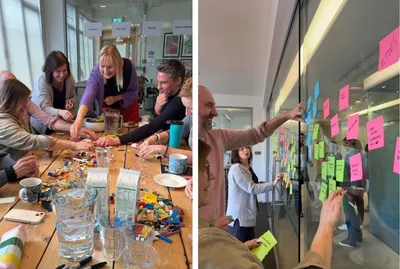
Building models that represented the current mental health service helped create a shared understanding, which we then used to develop a system snapshot of AWP’s services. We mapped the ‘things’ in the system across three themes:
- Constraints - what shapes and influences current mental health services? (e.g., number of trained specialists)
- Constructors - what enables repeat outcomes? (e.g., legal obligations such as the Mental Health Act, 1983)
- Actors - who influences or is influenced by the services? (e.g., charities offering homelessness support)
As is often the case when you bring the right people together, the real progress happens in the conversation. We facilitated those discussions to surface unknowns, challenge assumptions, spot hidden opportunities, and break things down in a way everyone could understand and align on.
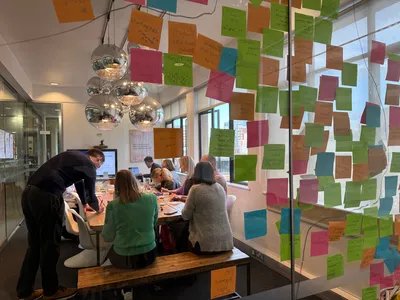
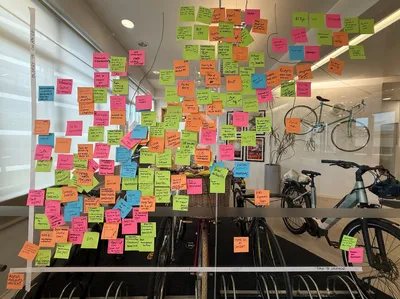
Once we had mapped the landscape with input from everyone in the room, we established a ‘zone of possibility’. With everything visible in front of them, AWP could lean into identifying different, achievable possibilities. Each participant could choose the ‘things’ they wanted to give their energy to, laddering up into quick wins with real momentum behind them.
By the end of the day, AWP left with tangible next steps towards the ambitious goals set out in their digital strategy. They’re now early into a new phase of implementing digital transformation and are already taking action on the quick wins identified. We’re excited to see how these will land.
The creative and person-centred methods Torchbox brings to possibility mapping really helped us develop our ideas for improvement, areas to prioritise and where we need to engage colleagues in our plans. The team really understood our challenges and goals, and were skilled in bringing together a diverse set of perspectives with a really innovative approach.
Moving forward, intentionally
So, what happens after a possibility mapping workshop?
The quick wins identified in any session help lead teams towards a portfolio of actions, essentially, a roster of next best moves. Its power lies in setting direction so you know where to start and how.
And, once you know? The next step in our innovation approach is to experiment, using structured, safe-to-try tests designed with, not for, the people in the system. This helps teams move forward faster, towards a better service or system.
Turn complexity into clear action
If you’re facing a complex challenge and unsure where to start, let’s talk about how Possibility Mapping can help.
More
-

What could your team achieve with an AI co-investment?
Lisa Ballam Head of Marketing, Trustee Director
-
Eight considerations before launching a public-facing AI tool
Mark Boyle Client Partner (Public Sector)
- See more posts