
How Breast Cancer Now is turning AI ideas into action
When Breast Cancer Now set out to explore how artificial intelligence could help their teams, they wanted to do it responsibly, collaboratively, and with real purpose.
Together, we’ve taken one of their early ideas and turned it into a working proof of concept that shows how AI can extend human capacity, not replace it, helping more people affected by breast cancer receive timely, compassionate support.
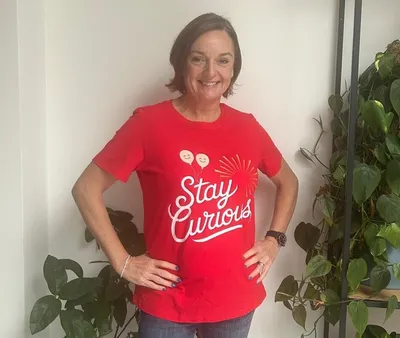
Dr Cath Biddle, with a reminder to stay curious.
Building a foundation for responsible AI
Last year, Breast Cancer Now partnered with us to explore the potential of artificial intelligence. In that first phase, led by Dr Cath Biddle, Director of Digital and Data, we worked together to raise awareness of AI across the organisation, identify opportunities for innovation, and build a shared framework for responsible use. That foundation is still guiding their work today, helping teams think confidently and ethically about where AI can add value.
Now, Breast Cancer Now is turning some of those ideas into action. After identifying more than a hundred potential use cases through the AI Opportunity Finder programme, we’ve moved from exploration to experimentation, creating a live proof of concept that puts AI to work in a real operational setting.
Finding the right opportunity
Through the first round of AI workshops, Breast Cancer Now identified 134 ways AI could help across the organisation, from content ideas and supporter engagement to data analysis. But one challenge stood out.
Across their social media and email channels, thousands of people reach out every month, asking questions, sharing experiences, or seeking help.
Each message matters, yet with only a small team managing incoming queries, it was hard to keep up with a growing demand.
We were receiving up to 2,800 messages a week, and it was getting increasingly difficult to read and triage them all, providing a response to those that needed it. We wanted to explore whether AI could help us increase our capacity while keeping the essential human touch.

Dr Cath Biddle Director of Digital and Data
Together, we ran a focused workshop to explore this challenge through the lens of agentic AI, a new generation of systems capable of reasoning, making decisions, and acting across workflows with a human in the loop.
In just two and a half hours, we went from exploring what’s possible to defining prioritised workflows, success measures, and early ROI indicators. From there, we moved on to prototyping.
Designing and building the proof of concept
Within hours of wrapping the workshop, we mapped Breast Cancer Now’s service flows, system dependencies, and governance requirements. We designed an agentic workflow that blended human oversight with automated triage and drafting, always aligning with Breast Cancer Now’s principles and data standards.
Integration with Microsoft Outlook and Brandwatch was essential from the start, since both act as triggers for the workflow. Using a modular architecture, we experimented rapidly with different models, Claude for nuanced, human-like drafting, and Gemini for efficient triage and routing.
The prototype was designed to:
- Scan and triage incoming messages from email and social platforms (via Brandwatch)
- Draft suggested responses using Breast Cancer Now’s existing content sources (SharePoint FAQs, guidance documents, and more)
- Flag complex or sensitive messages for prioritised human review
- Log every action so nothing slips through the cracks
This created a human-in-the-loop model where AI takes on the heavy lifting of sorting, drafting, and routing, while people retain full oversight and control.
We also developed transparent costing and process tracking, so every action and model call could be measured, compared, and improved. By building on our organisational knowledge and previous prototypes, we were able to accelerate development and focus on what really mattered - helping the team respond faster, consistently, and compassionately.
What we learnt
Even at this early stage, the results were promising:
- The potential to increase response coverage from 8 percent to near-total
- Faster response times, moving from days to hours
- Reduced reliance on temporary staff, saving both time and cost
- Clear visibility over every query and action
- Freed-up capacity for higher-value, human-centred work
Early ROI modelling suggests the project could pay for itself within six months, generating around 80 pence in value for every pound invested in the first year, increasing to £1.40 for every pound by year three.
From proof to practice
The proof of concept is just the first step, but an important one. It shows how charities can move beyond abstract conversations about AI and start testing, learning, and scaling in ways that directly support their mission.
The next phase will focus on:
- Validating outcomes, measuring ROI, staff experience, and user satisfaction
- Refining the workflow, improving triage logic, and using staff feedback on draft responses to help the model learn and improve its suggestions over time.
- Integrating further, connecting with existing systems to scale safely
- Embedding ethics and transparency, ensuring every AI action aligns with Breast Cancer Now’s values
Looking ahead
For Breast Cancer Now, this proof of concept represents the bridge between understanding AI and using it. It shows how AI can extend the reach of human care rather than replace it, ensuring more people affected by breast cancer receive timely, compassionate support.
For us at Torchbox, it’s been inspiring to see what’s possible when curiosity meets collaboration. Working alongside Breast Cancer Now has shown how AI can support the people doing the most human work, giving teams more time, more focus, and more space for the conversations that matter most.
Looking to turn early AI ideas into practical, responsible experiments? We can help you get started.
Lisa Ballam Head of Marketing, Trustee Director
Get in touchMore
-

Low-Code AI: When Microsoft's Ecosystem is (and isn't) the answer
Olly Willans Chief Innovation Officer, Founder Trustee
-

Five ways charities can remain visible in the changing digital landscape
Jess Mackereth SEO Consultant
-

Build vs buy in the age of AI for the nonprofit sector
Ivan Teage Founding Director, Harmonic Action
- See more posts