

Five ways charities can remain visible in the changing digital landscape
The search landscape is shifting fast for charities and nonprofits. AI Overviews and AI Mode are drastically changing how people find information online.
Google Ad Grants accounts might not be performing as they once did, upper-funnel informational keywords are increasingly showing AI Overviews, and the traditional ten blue links are being pushed further down the results page.
The good news is that not everything is being impacted in the same way. We’re finding that services and products, things people can use or act on, are less affected because AI Overviews can’t replicate them.
With this in mind, we’ve outlined five things you can do right now to stay visible in this new search landscape.
1) Prioritise services and products
If you have a service or product, for example, a helpline or support group, focus on building its visibility and reach. Pages with this type of content are not being impacted in the same way as informational content, which is more likely to trigger AI Overviews.
Be directive in your ad copy: “Call our helpline”, “Use our tool”, “Book an appointment”, rather than “Learn about…”. The clearer you make the action, the more chance you have of cutting through.
Surface anything with clear action. Interactive tools like BMI calculators or due date checkers, online hearing tests, event sign-ups, or charity shops all provide people with something that AI can’t replicate.
It’s also important to demonstrate expertise and trust. Make sure service pages include information about how they are created or reviewed, with dates, named authors, or expert sign-off where relevant. These signals reinforce to both users and search engines that your content is reliable.
2) Use paid to bolster organic activity
AI Overviews are reducing clicks across the board, and our Ad Grants clients are seeing the impact. On average, we’ve seen a 47% drop in CTR and a ~60% drop in clicks across Grants accounts over the past few months. Lower CTRs mean weaker quality scores, which makes ads more expensive to run.
To compensate, it’s important to:
- Test broader keywords and targeting (exact match can’t keep up with how AI Overviews and AI Mode surface results).
- As above, keep ad copy directive: “Use our service”, “Access the tool”, “Donate today.”
- Test new channels and campaign types, such as Performance Max and AI Max, which are proving to be effective at generating more impressions and more traffic than historic campaign types.
Alongside this, think about your wider channel mix. AI-led search means you can’t rely on Google Grants alone. Consider moving your income-driving ads into a paid Google Ads account, where they will have more visibility.
We also recommend focusing on building and maintaining strong email lists to help you reach supporters across other channels.
3) Stay discoverable: bring social search into the mix
Social search is becoming a key part of how people find information online. Platforms like TikTok, Instagram and YouTube are now where many people start their journey, and Google is pulling this content into its own results.
Video builds credibility fast, especially when a real person talks through a service or explains what to do next. Try creating new video content that’s simple and practical. Make sure your video titles, descriptions and tags reflect the words people are actually searching for.
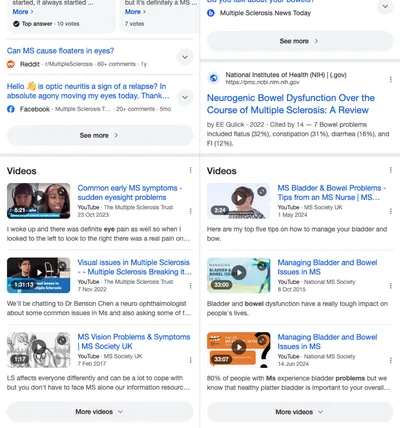
Examples of how the search results for MS symptom searches blend social posts and videos
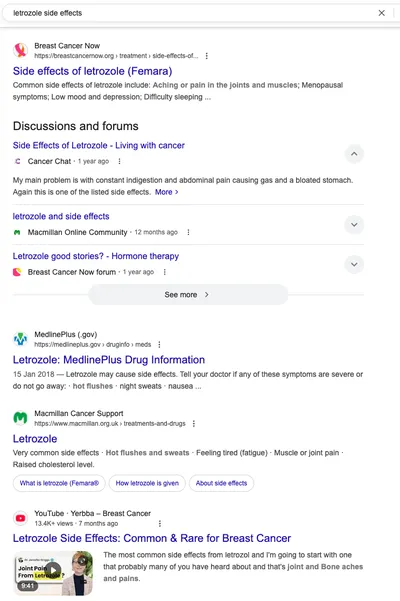
Tip: In Google Search Console, look at your top click-driving queries and review those searches in an incognito browser. Are videos and forums appearing? That’s a good indicator that this type of content is valuable to your audience.
4) Enhance your content with data from your forum
We’re also seeing more user-generated content from forums and discussion threads in Google results.
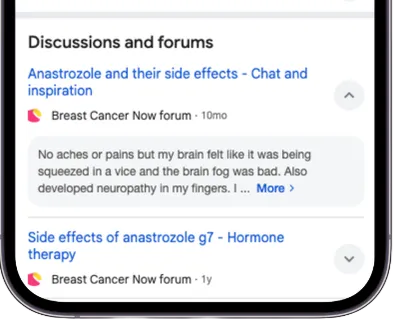
Google Search Console data from your forum can provide a rich source of user insight, showing how people search when they need support from others.
As well as being useful for your users, forum data can enhance your SEO efforts. People may find your organisation through personal or emotive searches, as well as general search terms. In some cases, medically reviewed content may be more appropriate to surface. A gap analysis between forum and website content can highlight opportunities to expand and better meet user needs.
We can support you to audit your forum and provide the following:
- Analysis of user search queries to identify gaps and opportunities
- Recommendations for linking between high-volume forum threads and related information on the main website
- Suggestions for optimising search appearance for key categories and landing pages on the forum
5) New search behaviour, same SEO principles
We know people are increasingly using LLMs such as ChatGPT, Perplexity, and Claude to find information, and these platforms are beginning to drive traffic to websites. The graph below shows referral session data from LLMs for our charity clients. Sessions are on the rise, so we need to consider how we can be visible as a trusted source of information in LLMs.

Graph showing referral session data from LLMs for our charity clients
Many of the factors that lead to a site appearing as a referred source in both AI Overviews and LLMs are the same as the core principles of good SEO. In a recent DOJ case summary, internal documents revealed that many of the ranking factors used by traditional Google results are also used to surface information in Gemini.
Additionally, while the ChatGPT and Microsoft partnership was well-known, recent insights from well-respected SEOs suggest that ChatGPT may be using Google search to surface web content. This means that AI tools may use existing ranked content to find their answers, indicating that ranking in Google and Bing remains highly relevant.
Therefore, SEO best practice is as important as ever. Focus on:
- Writing for humans, not search engines
- Building experience, expertise, authority, and trust (E-E-A-T)
- Maintaining a strong technical foundation for your site
If staying discoverable is a priority for your charity, we’d love to help you plan your next move.
More
-

Building a greener, more accessible digital home with WWF-US
Lisa Ballam Head of Marketing, Trustee Director
- See more posts