
Charity Leaders’ Breakfast: AI Show and Tell
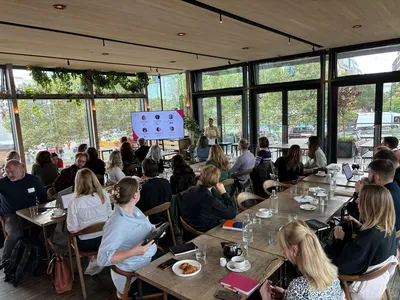
On 1st October, we gathered at The Lighterman in King’s Cross for our latest Charity Leaders’ Breakfast. This time, the focus was practical: a show and tell of how charities are putting AI to work.
We’ve moved past theory. Instead of asking “should we?”, charities are showing what’s happening right now, from transforming internal operations to changing how services are delivered.
What we heard
Dr Cath Biddle, Director of Digital and Data at Breast Cancer Now, opened the session. She described how her team has been exploring AI across research, operations, services and fundraising, always involving people with lived experience alongside staff. That process has led to pilots and new projects, and will form part of Breast Cancer Now’s new five-year strategy, which lists digital, innovation and AI as key enablers to achieving their vision. Cath’s message was clear: it’s not just about the tech, but about keeping people at the centre while exploring bold possibilities.
Next up was Darragh Field, Assistant Director of Digital Experience at the RSPCA. Darragh shared how his team has been tackling the age-old problem of messy, unreliable information. Their AI chatbot, Harriet, is now helping staff find answers in seconds instead of days, while surfacing inconsistencies that had previously gone unnoticed. More than the technology, it’s their approach to governance, culture and rapid test-and-learn that stood out. His advice was refreshingly practical: get your guardrails in place, release often, and focus on solving real problems.
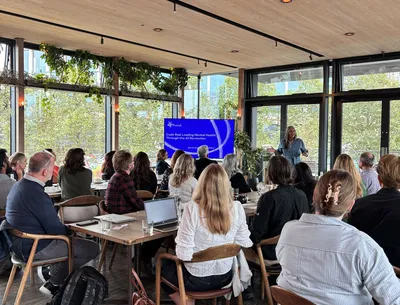
Dr Sarah Hughes, CEO of Mind, brought the big-picture view. AI is already shaping mental health care, from digital triage tools to CBT apps and chatbots. There’s real promise: digital therapies with solid evidence, tele-mental health that works for many people, and the potential for AI to cut admin so clinicians can focus on human connection.
But Sarah was clear about the risks: fewer than 5% of mental health apps are backed by trials, data can be biased or misused, and governance is patchy. Her call was for charities to act as both innovators and guardians, adopting what works, but also pushing for regulation, equity, and trust.
She ended with a challenge: the future of digital care will happen with or without us; the question is whether we shape it or let Big Tech do it for us.
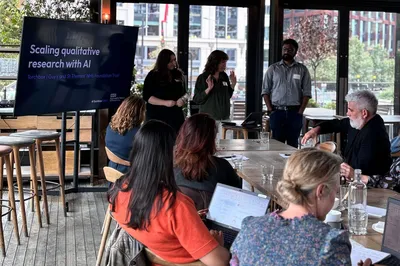
Emma Halahan, Product Manager at Guy’s and St Thomas’ NHS Trust, alongside Cassie Cardiff and Madhav Manoj from Torchbox, introduced Sonar, an AI-powered interviewer designed to scale qualitative research.
With so many staff working varied shift patterns, it’s hard to hear from everyone using traditional research methods. Sonar makes it easier, giving people a way to share their experiences in their own time.
It’s already helped surface insights from groups who are often missed, like porters, chaplains and community workers, and it’s proved valuable in validating themes at scale. Some staff even said they found it easier to open up to an AI than to a person.
The team were clear: AI isn’t here to replace human research, but to extend it. You can try using Sonar to reach more voices in your own research.
My reflections
What struck me across all four talks was the honesty. Each speaker shared not just what worked, but what didn’t, and that openness is exactly what the sector needs.
The conversation has shifted. Charities are no longer debating whether to engage with AI. They’re experimenting, sharing lessons, and asking how to do it responsibly and well.
If you’d like to join us at the next breakfast, or have a topic you think would be good for us to discuss next. Let me know via LinkedIn.
Looking for practical next steps with AI? Our Opportunity Finder Workshop will leave you with clear priorities and actions.
More
-

How charities can engage high-value donors in 2026
Marnie Winter-Burke Senior Digital Account Manager
-
Meta restrictions one year on: what charities can do now
Lisa Ballam Head of Marketing, Trustee Director
-

Seasonal giving: how to build a more resilient fundraising programme
Imogen Thomas Client Partner (Charity Sector)
- See more posts